Acetal quiz #1 Flashcards

Acetal quiz #1
Control buttons has been changed to "navigation" mode.
1/10
  • What is the structural definition of an acetal in organic chemistry?
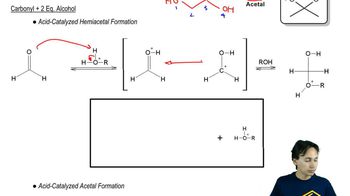
    An acetal is a compound in which a central carbon atom is bonded to two OR groups (where R is an alkyl or aryl group) and two other substituents, typically hydrogen or carbon. Acetals are formed from carbonyl compounds (aldehydes or ketones) through an acid-catalyzed reaction with alcohols, involving the formation of a hemiacetal intermediate followed by substitution of the remaining OH group with a second OR group.
  • Why are acetals considered stable in basic solutions?
    Acetals do not undergo hydrolysis in basic conditions, so they remain intact. This stability makes them useful for protecting carbonyl groups during base-catalyzed reactions.
  • What reagent is necessary to form a cyclic acetal from a carbonyl compound?
    A diol is required to form a cyclic acetal because it provides two hydroxyl groups connected by a carbon chain. This allows the formation of a ring structure during acetal formation.
  • Which step in the acetal formation mechanism involves the creation of a carbocation intermediate?
    The carbocation intermediate forms after the protonation of the OH group and the subsequent loss of water. This step is crucial for the nucleophilic attack by the second alcohol molecule.
  • What determines whether the forward or reverse acetal reaction occurs during protonation?
    Protonating the OH group drives the reaction forward to form an acetal, while protonating the OR group favors the reverse reaction to regenerate the carbonyl. The choice of group to protonate depends on the desired direction of the reaction.
  • Why is the acid-catalyzed mechanism required for full acetal formation?
    The acid-catalyzed mechanism is necessary because it enables the conversion of a hemiacetal to an acetal by facilitating the elimination of water. Base-catalyzed mechanisms can only produce hemiacetals, not full acetals.
  • What is the role of deprotonation in the acetal formation mechanism?
    Deprotonation occurs after nucleophilic addition to neutralize the intermediate and complete the transformation. It is the final step in both hemiacetal and acetal formation.
  • How does the mechanism for acetal formation simplify the learning process for students?
    The mechanism involves repeating similar steps twice, making it easier to memorize. The only challenging part is deciding which group to protonate during the hemiacetal to acetal conversion.
  • What makes water a good leaving group during acetal formation?
    Water is a good leaving group because, once protonated, it can easily dissociate from the intermediate, forming a carbocation. This facilitates the subsequent nucleophilic attack by the alcohol.
  • Why is memorizing the acetal formation mechanism important for organic chemistry exams?
    Acetal formation is a highly tested mechanism in organic chemistry courses. Understanding and memorizing the steps ensures students can answer exam questions and draw the mechanism accurately.