Addition Reaction quiz #1 Flashcards

Addition Reaction quiz #1
1 student found this helpful
Control buttons has been changed to "navigation" mode.
1/10
  • Which type of chemical equation represents an addition reaction in organic chemistry?
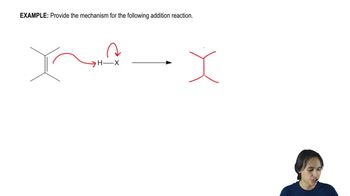
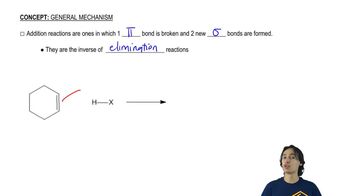
    An addition reaction is represented by an equation in which a molecule with a double bond (pi bond) reacts with another molecule (such as HX) to break the pi bond and form two new sigma bonds, resulting in a single-bonded product with added atoms.
  • What reaction conditions are required to achieve anti-Markovnikov addition to an alkene?
    Anti-Markovnikov addition to an alkene typically requires conditions that favor the addition of the electrophile to the less substituted carbon, such as the presence of peroxides in the addition of HBr, which alters the regioselectivity of the reaction.
  • What is the main result of an addition reaction in organic chemistry?
    An addition reaction breaks a pi bond (such as a double bond) and forms two new sigma bonds, increasing the number of single bonds in the molecule.
  • Which type of alkene addition reaction proceeds with only anti stereochemistry?
    Certain alkene addition reactions, such as halogenation (e.g., addition of Br2), proceed with anti stereochemistry, where the two atoms add to opposite sides of the double bond.
  • Describe the general mechanism when 1,3-butadiene undergoes electrophilic addition with HBr.
    When 1,3-butadiene reacts with HBr, the pi electrons attack the electrophilic hydrogen, forming a carbocation intermediate. The bromide ion then attacks the carbocation, leading to either 1,2- or 1,4-addition products depending on which carbocation intermediate is formed and stabilized.
  • What is the expected product when 1,3-butadiene reacts with propenal in an addition reaction?
    When 1,3-butadiene reacts with propenal (an electrophile), the nucleophilic diene can add to the electrophilic carbonyl carbon of propenal, resulting in a product where the diene and the aldehyde are joined through a new sigma bond, typically forming a substituted alkene or a Diels-Alder adduct depending on the reaction conditions.
  • Predict the product of the reaction between 1-butene and bromine (Br2).
    When 1-butene reacts with bromine (Br2), the double bond undergoes addition to form 1,2-dibromobutane, with the two bromine atoms adding across the former double bond.
  • What are the major 1,2- and 1,4-addition products formed when 1,3-butadiene undergoes an electrophilic addition reaction?
    The major 1,2-addition product is formed when the electrophile and nucleophile add to carbons 1 and 2 of 1,3-butadiene, while the 1,4-addition product is formed when they add to carbons 1 and 4, resulting in different regioisomers depending on the reaction conditions and intermediates.
  • How does the concept of dipoles help identify the electrophilic site in an addition reaction involving HX?
    Dipoles indicate that the halogen (X) is more electronegative than hydrogen, making hydrogen partially positive and thus the electrophilic site. This guides the nucleophilic double bond to attack the hydrogen during the reaction.
  • What happens to the carbons involved in the double bond after the initial attack by the nucleophile in an addition reaction?
    One carbon gains a new hydrogen, while the other forms a carbocation due to the loss of electron density. The carbocation is then attacked by the halide ion to complete the reaction and restore the octet.