What is the general product formed from an aldol addition reaction between two molecules of an aldehyde or ketone in the presence of base?
The general product of an aldol addition reaction is a beta-hydroxy carbonyl compound, known as an aldol, which contains both an alcohol (hydroxy) group and a carbonyl (aldehyde or ketone) group.
What is the major organic product formed when two molecules of butanal react together in the presence of base during an aldol addition?
When two molecules of butanal react together in the presence of base, the major organic product is 3-hydroxyhexanal, a beta-hydroxy aldehyde formed by the nucleophilic addition of the enolate of one butanal molecule to the carbonyl carbon of another.
What is the purpose of adding base in the aldol condensation reaction?
The purpose of adding base in the aldol condensation reaction is to deprotonate the alpha carbon of the carbonyl compound, generating an enolate ion that acts as a nucleophile and initiates the reaction by attacking another carbonyl compound.
Why is an excess of aldehyde often used in the aldol-dehydration reaction?
An excess of aldehyde is used in the aldol-dehydration reaction to favor the formation of the desired aldol product by increasing the likelihood that the enolate will react with an aldehyde molecule rather than undergoing side reactions or self-condensation.
What is the product formed when benzaldehyde reacts with acetone in the presence of sodium hydroxide?
When benzaldehyde reacts with acetone and sodium hydroxide, the product is a beta-hydroxy ketone (aldol addition product), which can further dehydrate to form an alpha-beta unsaturated ketone (enone) due to the stability provided by conjugation.
What is the mechanism of aldol condensation and what type of product does it yield?
The mechanism of aldol condensation involves base-induced formation of an enolate from a carbonyl compound, which then attacks another carbonyl compound to form a beta-hydroxy carbonyl (aldol). This product can spontaneously dehydrate to yield an alpha-beta unsaturated carbonyl compound (enone).
Why do beta-hydroxy carbonyl compounds formed in aldol condensation reactions often spontaneously dehydrate?
Beta-hydroxy carbonyl compounds often spontaneously dehydrate because the resulting alpha-beta unsaturated carbonyl (enone) is highly stabilized by conjugation, making the dehydration process energetically favorable even without strong acid or heat.
Why is it important to count the number of carbons in the product of an aldol condensation reaction?
Counting carbons ensures that the product has the correct number of atoms based on the reactants, preventing errors such as missing or extra carbons. Mistakes in carbon counting can result in drawing a completely different molecule.
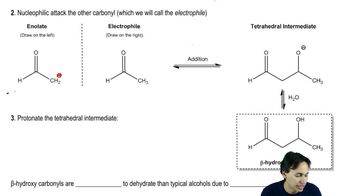
What is the recommended way to draw the enolate and electrophile when visualizing the aldol condensation mechanism?
The enolate should be drawn on the left with its negative charge close to the electrophile, and the electrophile should be on the right with its smallest group oriented toward the enolate. This arrangement simplifies visualization and helps avoid mistakes in the mechanism.
What is the main reason that beta-hydroxy carbonyls formed in aldol condensations dehydrate so easily compared to typical alcohols?
The dehydration product is highly stabilized by conjugation, making the loss of water energetically favorable. As a result, dehydration can occur spontaneously under both acidic and basic conditions without the need for strong acid or heat.