Back

Alkyne Hydration quiz

Control buttons has been changed to "navigation" mode.
1/15
  • What is a vinyl alcohol?

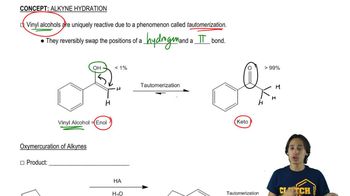
    A vinyl alcohol is an alcohol group directly attached to a double bond (alkene).
  • What is tautomerization in the context of alkyne hydration?

    Tautomerization is the reversible process where a hydrogen and a pi bond swap positions, converting an enol to a keto form.
  • What is the favored product after tautomerization of a vinyl alcohol?

    The keto form (ketone or aldehyde) is highly favored over the enol (vinyl alcohol) form.
  • What does the term 'enol' mean?

    Enol refers to a compound with an alcohol group attached to a carbon-carbon double bond.
  • What is the product of Markovnikov hydration of an alkyne?

    Markovnikov hydration of an alkyne produces a ketone after tautomerization.
  • Which reagents are used for Markovnikov addition of water to alkynes?

    Oxymercuration and acid-catalyzed hydration are used for Markovnikov addition of water to alkynes.
  • What is the intermediate formed during hydration of alkynes before tautomerization?

    The intermediate is an enol (vinyl alcohol).
  • What is the product of anti-Markovnikov hydration (hydroboration) of an alkyne?

    Anti-Markovnikov hydration (hydroboration) of an alkyne produces an aldehyde after tautomerization.
  • What determines whether the final product of alkyne hydration is a ketone or an aldehyde?

    The position of the carbon and the presence of a hydrogen determine if the product is a ketone (internal) or an aldehyde (terminal).
  • Why are enols generally not isolated as products in alkyne hydration?

    Enols rapidly tautomerize to the more stable keto form, so they are rarely isolated.
  • What is the role of boron reagents in alkyne hydration?

    Boron reagents are used in hydroboration to achieve anti-Markovnikov addition of water to alkynes.
  • What happens to the hydrogen atom during tautomerization of an enol?

    The hydrogen atom and the pi bond switch places, resulting in a carbonyl group.
  • What is the difference in product location between Markovnikov and anti-Markovnikov hydration of alkynes?

    Markovnikov hydration adds the alcohol to the more substituted carbon (leading to a ketone), while anti-Markovnikov adds to the less substituted carbon (leading to an aldehyde).
  • What functional group is formed after tautomerization of an enol from a terminal alkyne?

    An aldehyde is formed after tautomerization of an enol from a terminal alkyne.
  • Why is the keto form more stable than the enol form?

    The keto form is more stable due to the strength and stability of the carbonyl double bond compared to the enol's structure.