Control buttons has been changed to "navigation" mode.
1/10
Terms in this set (10)
What is an aromatic heterocycle, and what are the key criteria for a heterocyclic compound to be considered aromatic?
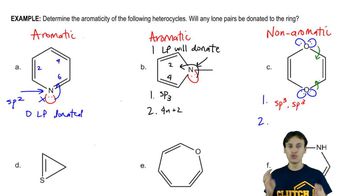
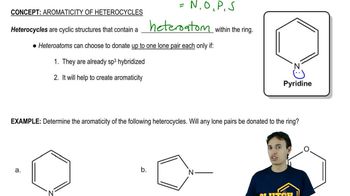
An aromatic heterocycle is a ring structure containing at least one heteroatom (such as nitrogen, oxygen, phosphorus, or sulfur) that satisfies the criteria for aromaticity. For a heterocycle to be aromatic, it must have a conjugated pi system that follows Huckel's rule (4n+2 pi electrons), and any lone pairs from heteroatoms are counted toward the pi system only if the heteroatom is sp3 hybridized and donating the lone pair helps achieve aromaticity.
Which atoms are commonly found as heteroatoms in aromatic heterocycles?
Common heteroatoms include nitrogen, oxygen, phosphorus, and sulfur. These non-carbon atoms are often present in ring structures.
Why does the presence of a heteroatom complicate the determination of aromaticity in a ring?
Heteroatoms often have lone pairs that may or may not participate in the conjugated pi system. Deciding whether to count these lone pairs toward aromaticity requires additional rules.
How many lone pairs can a heteroatom donate to the aromatic ring system?
A heteroatom can donate up to one lone pair to the ring system. Even if it has more than one lone pair, only one may be considered for aromaticity.
What hybridization must a heteroatom have to donate a lone pair to the aromatic pi system?
The heteroatom must be sp3 hybridized to donate a lone pair. If it is sp2 or sp hybridized, its lone pair will not be donated to the ring.
Under what condition will a heteroatom donate its lone pair to the ring's pi system?
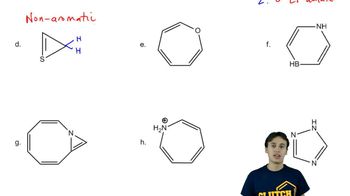
A heteroatom will donate its lone pair only if it helps the ring achieve aromaticity according to Huckel's rule. If donating the lone pair would make the ring anti-aromatic or non-aromatic, it will not be donated.
Why is pyridine considered a useful example when discussing aromatic heterocycles?
Pyridine contains a nitrogen atom with a basic lone pair and is commonly used in acid-base reactions. Its structure helps illustrate how lone pairs on heteroatoms affect aromaticity.
What is the role of the basic lone pair on nitrogen in pyridine with respect to aromaticity?
The basic lone pair on nitrogen in pyridine does not participate in the aromatic pi system. It remains available for acid-base reactions rather than contributing to Huckel's rule.
What should you analyze to determine if a lone pair on a heteroatom contributes to aromaticity?
You should check the hybridization of the heteroatom and whether donating the lone pair helps the ring satisfy Huckel's rule. Only if both criteria are met should the lone pair be counted.
Can oxygen donate both of its lone pairs to the aromatic ring system?
No, oxygen can donate only one of its lone pairs to the ring system. The other lone pair remains non-conjugated and does not participate in aromaticity.