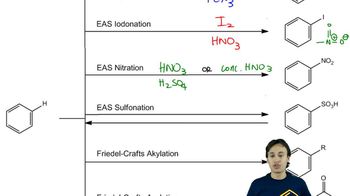
What does the ring in the center of a benzene molecule represent in organic chemistry?
The ring in the center of a benzene molecule represents the delocalized pi electrons that are shared equally among all six carbon atoms, indicating aromaticity and resonance stabilization.
What are two general methods to prepare substituted benzene compounds from benzene using Electrophilic Aromatic Substitution (EAS) reactions?
Two general methods to prepare substituted benzene compounds from benzene are: (1) Halogenation, which uses a diatomic halogen (Br2 or Cl2) and a Lewis acid catalyst (FeBr3 or FeCl3) to introduce a halogen atom; and (2) Friedel-Crafts reactions, which include alkylation (using an alkyl halide and AlCl3) to add an alkyl group, or acylation (using an acid chloride and AlCl3) to add an acyl group.
Why is a Lewis acid catalyst necessary for EAS halogenation of benzene with Br2 or Cl2?
A Lewis acid catalyst is needed because Br2 or Cl2 alone are not strong enough electrophiles to react with benzene. The catalyst activates the halogen, making it sufficiently electrophilic for substitution.
What reagent is uniquely required for the iodination of benzene in EAS reactions?
Iodination of benzene requires nitric acid (HNO3) instead of the typical iron-based Lewis acid catalyst. This is because iodine does not react with FeX3 catalysts in EAS.
How can the nitro group be introduced to benzene using different acid combinations?
The nitro group can be introduced using a mixture of nitric acid (HNO3) and sulfuric acid (H2SO4) or by using concentrated HNO3 alone. Both methods generate the active electrophile needed for nitration.
What is the functional group added to benzene during sulfonation, and how is it reversed?
Sulfonation adds a sulfonic acid group to benzene, and the reaction can be reversed (desulfonation) using dilute sulfuric acid or steam. This reversibility is unique among EAS reactions.
What is the most common catalyst used in Friedel-Crafts alkylation and acylation reactions?
Aluminum chloride (AlCl3) is the most common catalyst used in both Friedel-Crafts alkylation and acylation. It acts as a strong Lewis acid to generate the required electrophile.
What is the difference between the groups added to benzene in Friedel-Crafts alkylation versus acylation?
Friedel-Crafts alkylation adds an alkyl (R) group, while acylation adds an acyl group, typically resulting in a ketone. The nature of the group depends on the starting reagent.
How can carbocation intermediates be generated for reactions with benzene outside of typical Friedel-Crafts conditions?
Carbocation intermediates can be generated using HF with a double bond or BF3 with an alcohol. These strong electrophiles can then react with benzene to add R groups.
Why is it important to match the halogen in the catalyst with the halogen in the electrophile during EAS halogenation?
Matching the halogen ensures the catalyst effectively activates the electrophile for substitution. Using different halogens may hinder the reaction or affect the mechanism.