Condensation Reactions quiz Flashcards
Condensation Reactions quiz
You can tap to flip the card.
Control buttons has been changed to "navigation" mode.
1/10
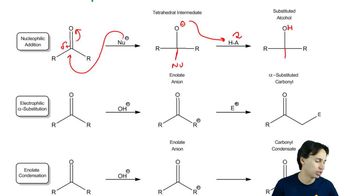
What is a condensation reaction in organic chemistry?A condensation reaction involves two molecules combining to form a larger molecule with the loss of a smaller molecule.What role do enolates play in condensation reactions?Enolates act as reactive intermediates that can react with electrophiles or undergo self-condensation in the absence of electrophiles.Why are alpha protons important in enolate-mediated condensation reactions?Alpha protons are necessary for the formation of enolates from deprotonated alpha carbons, which are crucial for these reactions.What happens when an enolate reacts with a non-enolated version of itself?The enolate undergoes nucleophilic addition, forming a tetrahedral intermediate and leading to a condensation reaction.What is the aldol reaction?The aldol reaction involves the combination of ketones and aldehydes to form a molecule containing both alcohol and aldehyde groups.What is the Claisen condensation?The Claisen condensation involves two esters reacting to produce a beta-dicarbonyl compound, specifically a beta-ketoester.How does the absence of an electrophile affect enolate reactions?In the absence of an electrophile, enolates can react with themselves, leading to self-condensation reactions.What is the significance of nucleophilic addition in condensation reactions?Nucleophilic addition is a key step where enolates attack carbonyls, forming intermediates that lead to condensation products.What type of intermediate is formed during enolate condensation reactions?A tetrahedral intermediate is formed during enolate condensation reactions.What are the two main types of enolate condensation reactions discussed?The two main types are the aldol reaction and the Claisen condensation.