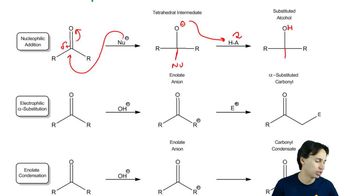
What is a condensation reaction in organic chemistry, and how does it typically occur in enolate-mediated processes?
A condensation reaction in organic chemistry is a process where two molecules combine to form a larger molecule with the loss of a smaller molecule, such as water or alcohol. In enolate-mediated condensation reactions, an enolate ion (formed by deprotonation of an alpha carbon) reacts with another molecule, often a non-enolated version of itself, resulting in nucleophilic addition and the formation of a new carbon-carbon bond. Examples include the aldol reaction (between ketones or aldehydes) and the Claisen condensation (between esters).
Which types of organic transformations are classified as condensation reactions, particularly those involving enolates?
Transformations classified as condensation reactions include the aldol reaction, where two ketones or aldehydes combine to form a molecule containing both alcohol and aldehyde groups, and the Claisen condensation, where two esters react to produce a beta-dicarbonyl compound, specifically a beta-ketoester. Both reactions involve enolate formation and result in the combination of two molecules with the loss of a smaller molecule.
Why are alpha protons necessary for enolate-mediated condensation reactions to occur?
Alpha protons are necessary because their removal by a base generates the enolate anion. Without an alpha proton, enolate formation and thus the condensation reaction cannot proceed.
What happens to an enolate in the absence of an external electrophile during a condensation reaction?
In the absence of an external electrophile, the enolate reacts with a non-enolated version of itself. This leads to self-condensation, forming a larger molecule.
What type of intermediate is formed when an enolate attacks a carbonyl compound in a condensation reaction?
A tetrahedral intermediate is formed when the enolate attacks the carbonyl carbon. This intermediate is then typically protonated to yield the final product.
How does the nucleophilicity of enolates influence their behavior in condensation reactions?
Enolates are highly nucleophilic due to their negative charge on the alpha carbon. This allows them to attack electrophilic carbonyl carbons, facilitating condensation reactions.
What is the structural feature of the product formed from the Claisen condensation of two esters?
The product of a Claisen condensation is a beta-dicarbonyl compound, specifically a beta-ketoester. This structure features two carbonyl groups separated by one carbon.
In the context of condensation reactions, what is meant by 'self-condensation'?
Self-condensation refers to a reaction where a molecule forms an enolate and then reacts with another molecule of itself. This results in the formation of a larger molecule from two identical starting materials.
What functional groups are present in the product of an aldol reaction?
The product of an aldol reaction contains both an alcohol and a carbonyl group. This combination gives the reaction its name, 'aldol,' from 'aldehyde' and 'alcohol.'
Why is the enolate considered a key intermediate in many condensation reactions?
The enolate is a key intermediate because its nucleophilic alpha carbon can attack electrophilic carbonyl carbons. This reactivity enables the formation of new carbon-carbon bonds in condensation reactions.