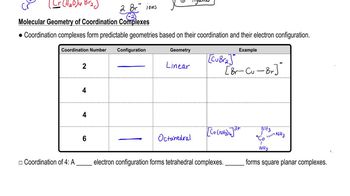
How do you classify coordination complexes according to their coordination number, and what are the most common coordination numbers and their associated geometries?
Coordination complexes are classified by the coordination number, which is the number of ligands directly bonded to the central transition metal ion. The most common coordination numbers are 2 (linear geometry), 4 (tetrahedral or square planar geometry, depending on the metal's electron configuration), and 6 (octahedral geometry).
What role do counter ions play in coordination complexes?
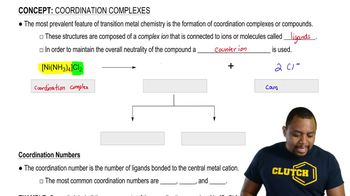
Counter ions balance the overall charge of the coordination complex to maintain electrical neutrality. They are found outside the brackets in the chemical formula.
How can you distinguish between the complex ion and the counter ion in a coordination complex formula?
The complex ion is enclosed in brackets and contains the transition metal and ligands, while the counter ion is written outside the brackets. The counter ion is responsible for balancing the charge of the complex ion.
What determines the overall charge of a complex ion in a coordination complex?
The overall charge of a complex ion is determined by the charge of the central transition metal and the charges of the ligands. If the ligands are neutral, the charge comes solely from the metal ion.
Give two examples of neutral ligands commonly found in coordination complexes.
Ammonia and water are two examples of neutral ligands. They do not contribute any charge to the complex ion.
Name two negatively charged ligands that can be found in coordination complexes.
Cyanide ion and azide ion are examples of negatively charged ligands. Halide ions can also act as negative ligands.
Why is electron configuration important when determining the geometry of coordination complexes with a coordination number of 4?
Electron configuration helps determine whether the geometry will be tetrahedral or square planar. A d10 configuration favors tetrahedral geometry, while a d8 configuration favors square planar geometry.
What is the geometry of a coordination complex with a coordination number of 6, and does electron configuration affect it?
The geometry is always octahedral for a coordination number of 6. Electron configuration does not affect the geometry in this case.
How does the geometry of a coordination complex with a coordination number of 2 differ from those with higher coordination numbers?
A coordination number of 2 always results in a linear geometry. Electron configuration does not influence the geometry for coordination number 2.
What is the electron configuration of zinc in both its neutral and +2 ion forms, and how does this affect its complex geometry?
Zinc has a d10 electron configuration in both its neutral and +2 ion forms. This configuration leads to tetrahedral geometry in its coordination complexes.