Back

Decarboxylation Mechanism definitions

Control buttons has been changed to "navigation" mode.
1/14
  • Decarboxylation

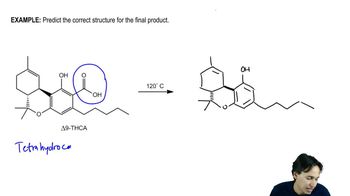
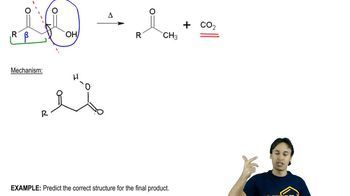
    A heat-driven process removing a carboxylic acid group as CO2, leaving a carbonyl-containing compound.
  • Beta-Keto Carboxylic Acid

    A molecule featuring a carbonyl group two atoms away from a carboxylic acid, enabling easy CO2 loss.
  • Carbonyl Group

    A functional group with a carbon double-bonded to oxygen, often formed after CO2 elimination.
  • CO2 Gas

    A gaseous byproduct released when a carboxylic acid group is cleaved from a molecule.
  • Concerted Mechanism

    A reaction pathway where multiple bond changes occur simultaneously in a single step.
  • Intermediate Alcohol

    A transient species with an -OH group formed before tautomerization to a ketone.
  • Tautomerization

    A rapid rearrangement shifting a hydrogen and a double bond, converting an enol to a ketone.
  • Enol

    A compound with a hydroxyl group directly bonded to a double-bonded carbon atom.
  • Ketone

    A molecule with a carbonyl group bonded to two carbon atoms, often the final product after tautomerization.
  • Heat Mediation

    The requirement of elevated temperature to initiate and drive the decarboxylation process.
  • Pi Bond

    A type of covalent bond formed by sideways overlap of p orbitals, crucial in double bonds.
  • Single Bond Cleavage

    The breaking of a sigma bond, such as between a carboxyl group and the rest of the molecule during decarboxylation.
  • Vinyl Alcohol

    An unstable alcohol with a hydroxyl group attached to a carbon-carbon double bond, prone to tautomerization.
  • Enolate Chemistry

    The study of species formed by deprotonation of enols, important in understanding tautomerization.