By what mechanism does the acid-catalyzed dehydration of tertiary alcohols occur?
The acid-catalyzed dehydration of tertiary alcohols occurs by the E1 (unimolecular elimination) mechanism, which involves formation of a carbocation intermediate followed by beta elimination to form a double bond.
Why are alcohols considered poor leaving groups in acid-catalyzed dehydration reactions?
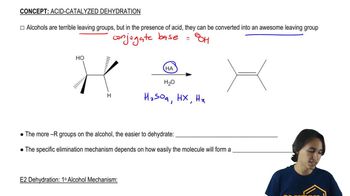
Alcohols are poor leaving groups because the hydroxide ion (OH-) formed is a strong base and unstable. Protonation converts the alcohol into water, a much better leaving group due to its neutrality.
What is the role of protonation in the acid-catalyzed dehydration of alcohols?
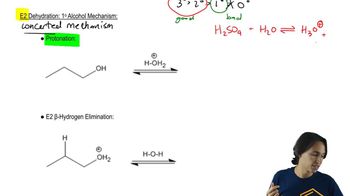
Protonation transforms the alcohol into a better leaving group by converting it into water. This step is essential for both E1 and E2 dehydration mechanisms.
Which acids are commonly used to catalyze the dehydration of alcohols?
Strong acids like H2SO4, hydrogen halides, and sometimes phosphoric acid are commonly used. These acids facilitate the protonation of the alcohol, enabling the reaction.
How does the structure of an alcohol affect its ease of dehydration?
Tertiary alcohols dehydrate most easily, followed by secondary, then primary alcohols. Methanol cannot undergo dehydration because it lacks a beta hydrogen.
What is the difference between acid-catalyzed hydration and dehydration reactions?
Hydration adds water to a double bond to form an alcohol, while dehydration removes water from an alcohol to form a double bond. The direction depends on the starting material and reaction conditions.
What happens if a primary alcohol can rearrange to form a more stable carbocation during dehydration?
If a primary alcohol can rearrange to a tertiary carbocation, it will undergo the E1 mechanism instead of E2. Carbocation rearrangement allows for a more stable intermediate and changes the reaction pathway.
Why is it important that the acid catalyst is regenerated at the end of the dehydration reaction?
Regeneration of the acid ensures it acts as a true catalyst, lowering activation energy without being consumed. This maintains the definition and function of a catalyst in the reaction.
What is the significance of carbocation shifts in the E1 dehydration mechanism?
Carbocation shifts can lead to more stable intermediates and the formation of constitutional isomers. This affects the final product distribution in the reaction.
In the E2 mechanism for primary alcohol dehydration, what is the role of the beta hydrogen?
The beta hydrogen is eliminated along with the leaving group in a concerted step to form the double bond. Its presence is necessary for the elimination to occur.
 Back
Back

 05:20
05:20