Dehydrohalogenation quiz #1 Flashcards

Dehydrohalogenation quiz #1
Control buttons has been changed to "navigation" mode.
1/10
  • What is the major organic product formed in a dehydrohalogenation (E2) reaction of an alkyl halide with a strong base?
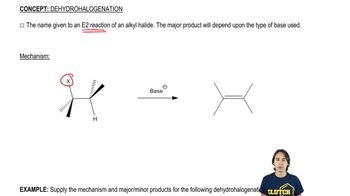
    The major organic product of a dehydrohalogenation (E2) reaction is an alkene formed by the elimination of a beta hydrogen and a halogen (leaving group) from the alkyl halide. The base abstracts a beta hydrogen that is antiperiplanar to the leaving group, resulting in the formation of a double bond between the alpha and beta carbons. The specific alkene formed (Zaitsev or Hofmann product) depends on the structure of the alkyl halide and the base used.
  • Why is the antiperiplanar geometry important in the E2 dehydrohalogenation mechanism?
    Antiperiplanar geometry allows the base to effectively abstract the beta hydrogen while the leaving group departs in the opposite direction. This orientation maximizes orbital overlap for the formation of the new pi bond.
  • How does the substitution level of the alkyl halide affect the likelihood of dehydrohalogenation via E2?
    More substituted alkyl halides, such as secondary or tertiary, favor elimination over less substituted ones. This is because increased substitution stabilizes the resulting alkene product.
  • What are the three key electron movements in the E2 dehydrohalogenation mechanism?
    The base abstracts a beta hydrogen, electrons from the C-H bond form a double bond, and the leaving group is expelled. These steps occur simultaneously in a concerted reaction.
  • What role does the base play in the dehydrohalogenation reaction?
    The base removes a beta hydrogen from the alkyl halide, initiating the elimination process. Its strength and bulkiness can influence which alkene product is formed.
  • What are the final products of a dehydrohalogenation reaction?
    The reaction yields a new alkene, the conjugate acid of the base, and the halide ion from the leaving group. These are formed as a result of the elimination process.
  • How does the choice of base affect the regioselectivity of the alkene product in dehydrohalogenation?
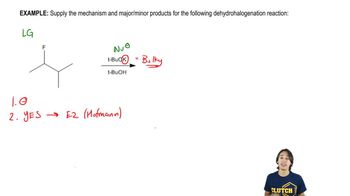
    A bulky base tends to favor the Hofmann product, which is the less substituted alkene. A smaller, strong base usually leads to the Zaitsev product, the more substituted alkene.
  • What is meant by 'beta hydrogen elimination' in the context of dehydrohalogenation?
    Beta hydrogen elimination refers to the removal of a hydrogen atom from the carbon adjacent to the one bearing the leaving group. This step is essential for forming the double bond in the product.
  • Why is dehydrohalogenation considered a concerted reaction?
    All bond-breaking and bond-forming events occur simultaneously in a single step. This means there is no intermediate formed during the process.
  • What is the significance of using a Newman projection when analyzing dehydrohalogenation?
    A Newman projection helps visualize the antiperiplanar arrangement of the beta hydrogen and leaving group. This visualization is crucial for understanding the stereochemical requirements of the E2 mechanism.