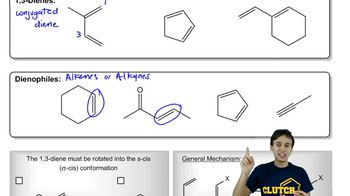
Which types of dienes are able to undergo a Diels-Alder reaction?
Only conjugated 1,3-dienes can undergo a Diels-Alder reaction, as isolated dienes like 1,4-dienes do not have adjacent double bonds and are not suitable.
What structural feature makes a diene the least reactive in a Diels-Alder reaction?
A diene that cannot adopt the s-cis conformation or is not conjugated (such as an isolated diene) is the least reactive in a Diels-Alder reaction.
What are the key characteristics of the Diels-Alder reaction?
The Diels-Alder reaction is a heat-catalyzed, reversible pericyclic reaction between a conjugated 1,3-diene and a dienophile (alkene or alkyne), always forming a 6-membered ring and retaining the stereochemistry of substituents.
Why is a solvent like xylene (dimethylbenzene) used in the Diels-Alder reaction?
Xylene is used as a solvent in the Diels-Alder reaction because it has a high boiling point, allowing the reaction to be heated sufficiently to proceed efficiently.
What structural feature makes a dienophile the least reactive in a Diels-Alder reaction?
A dienophile lacking electron-withdrawing groups is the least reactive in a Diels-Alder reaction, as electron-withdrawing groups increase dienophile reactivity.
What structural feature makes a diene the most reactive in a Diels-Alder reaction?
A diene that is conjugated and can easily adopt the s-cis conformation is the most reactive in a Diels-Alder reaction.
What is correct about the formation of the exo product in a Diels-Alder reaction?
The exo product in a Diels-Alder reaction refers to the orientation of substituents on the newly formed ring, and its formation depends on the approach of the dienophile and the relative positions of substituents; stereochemistry is retained from the starting materials.
What is the general mechanism of the Diels-Alder reaction?
The Diels-Alder reaction mechanism involves a conjugated 1,3-diene in the s-cis conformation reacting with a dienophile (alkene or alkyne) via a concerted pericyclic process, forming two new sigma bonds and one new pi bond to yield a 6-membered ring.
How can you deconstruct a Diels-Alder adduct to identify the original diene and dienophile?
To deconstruct a Diels-Alder adduct, identify the 6-membered ring with a double bond, then break the two new sigma bonds formed and convert the single bonds back to double bonds to reveal the original 1,3-diene and dienophile.
How do you determine the product of a Diels-Alder reaction between a given diene and dienophile?
To determine the product, ensure the diene is conjugated and in the s-cis conformation, then connect the ends of the diene to the ends of the dienophile, forming a 6-membered ring with a new double bond and retaining the stereochemistry of substituents.
What is the expected product of the Diels-Alder reaction between anthracene and maleic anhydride?
The Diels-Alder reaction between anthracene (acting as the diene) and maleic anhydride (the dienophile) yields a 6-membered ring adduct fused to the anthracene core, with the anhydride group attached to the new ring.
How do you draw one enantiomer of the major product of a Diels-Alder reaction involving a trans dienophile?
For a Diels-Alder reaction with a trans dienophile, draw the 6-membered ring product with the substituents from the dienophile in trans positions, and show one possible spatial arrangement to represent one enantiomer.
How do you identify the expected major product of a Diels-Alder reaction?
The expected major product is a 6-membered ring formed by the reaction of a conjugated 1,3-diene (in s-cis conformation) and a dienophile, with the stereochemistry of substituents retained from the starting materials.