What is the electrophile involved in the nitration of aromatic compounds?
The electrophile in aromatic nitration is the nitronium ion (NO2+), which is a strong electron-loving species that reacts with the benzene ring in electrophilic aromatic substitution.
How many electrophilic centers are present in acetyl chloride (CH3COCl)?
Acetyl chloride (CH3COCl) has one electrophilic center, which is the carbonyl carbon. This carbon is highly electron-deficient due to the electron-withdrawing effects of both the carbonyl oxygen and the chlorine atom, making it susceptible to nucleophilic attack.
What is the first step in the general mechanism for electrophilic aromatic substitution?
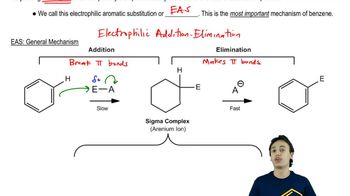
The first step in the general mechanism for electrophilic aromatic substitution is the addition of an electrophile to the benzene ring, forming a high-energy intermediate called the sigma complex (or arenium ion).
What types of electrophiles can participate in electrophilic aromatic substitution reactions?
Electrophilic aromatic substitution reactions can involve various strong electrophiles, such as halonium ions (e.g., Br+ or Cl+), nitronium ion (NO2+), sulfonium ion (SO3H+), and acylium ion (RCO+), among others. These electrophiles are capable of temporarily disrupting aromaticity to allow substitution on the benzene ring.
Why does benzene prefer substitution reactions over addition reactions?
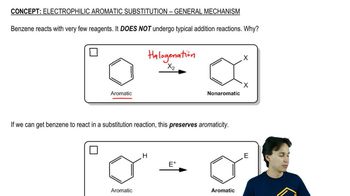
Benzene prefers substitution reactions because addition would disrupt its aromaticity, making the molecule less stable. Substitution allows the aromatic system to be restored after the reaction.
What is the main reason that typical halogenation reactions do not work on benzene?
Typical halogenation would result in a non-aromatic product by breaking conjugation in the ring. Loss of aromaticity makes the product much less stable.
What is another name for the sigma complex formed during EAS?
The sigma complex is also called an arenium ion. It is a high-energy intermediate stabilized by resonance.
How is the positive charge in the sigma complex stabilized?
The positive charge is stabilized by resonance, as the cation can be delocalized over three different carbons in the ring. This delocalization distributes the charge and lowers the energy of the intermediate.
What role does the conjugate base play in the EAS mechanism?
The conjugate base acts as a base to remove a proton from the sigma complex during the elimination step. This restores the aromaticity of the ring by reforming the double bond.
Which step of the EAS mechanism is the rate-determining step and why?
The formation of the sigma complex (addition step) is the rate-determining step. This is because creating the high-energy, non-aromatic intermediate is energetically difficult.