Epimerization quiz Flashcards

Epimerization quiz
Control buttons has been changed to "navigation" mode.
1/10
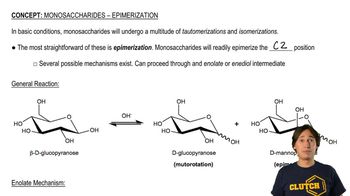
  • At which carbon position does epimerization typically occur in monosaccharides?
    Epimerization typically occurs at the C2 position in monosaccharides.
  • What is the main reason bases are generally avoided with monosaccharides?
    Bases are avoided because they can lead to complex mixtures due to multiple isomerizations.
  • What is the result of epimerization at the C2 position of beta-D-glucopyranose?
    Epimerization at the C2 position of beta-D-glucopyranose can convert it into D-mannopyranose.
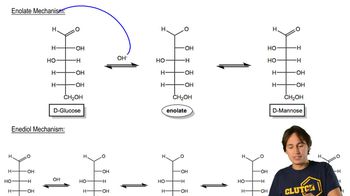
  • What is the role of the enolate mechanism in epimerization?
    The enolate mechanism involves deprotonation of the alpha carbon, forming an enolate that can lose stereochemical information at C2.
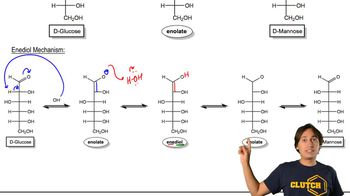
  • How does the enediol mechanism differ from the enolate mechanism?
    The enediol mechanism forms an enediol intermediate with two hydroxyl groups, leading to possible inversion at C2.
  • What happens to the stereochemistry of the hydroxyl group during epimerization?
    The stereochemistry of the hydroxyl group at C2 can racemize, allowing it to switch positions.
  • Why is the C2 position of a monosaccharide susceptible to epimerization in base?
    The C2 position is susceptible due to the acidity of the alpha carbon, which is more easily deprotonated.
  • What is the significance of the enediol intermediate in the epimerization process?
    The enediol intermediate allows for the loss of stereochemical information, enabling the hydroxyl group to switch positions.
  • What is the outcome of the enolate mechanism in terms of stereochemistry?
    The enolate mechanism results in the loss of stereochemical information at C2, allowing for racemization.
  • What is the final result of both the enolate and enediol mechanisms in epimerization?
    Both mechanisms result in the formation of an epimer with the hydroxyl group at C2 in a different stereochemical position.