Fischer Projection quiz #1 Flashcards

Fischer Projection quiz #1
Control buttons has been changed to "navigation" mode.
1/10
  • What is a Fischer projection and how does it represent the three-dimensional structure of a molecule?
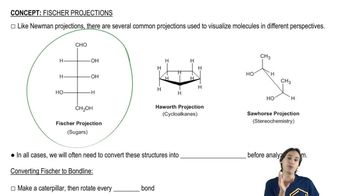
    A Fischer projection is a two-dimensional representation used in organic chemistry, especially for sugars. In a Fischer projection, vertical bonds are depicted as going into the page (dashes), and horizontal bonds are coming out of the page (wedges), representing the three-dimensional spatial orientation of the molecule.
  • How can you convert a Fischer projection into a bond line structure?
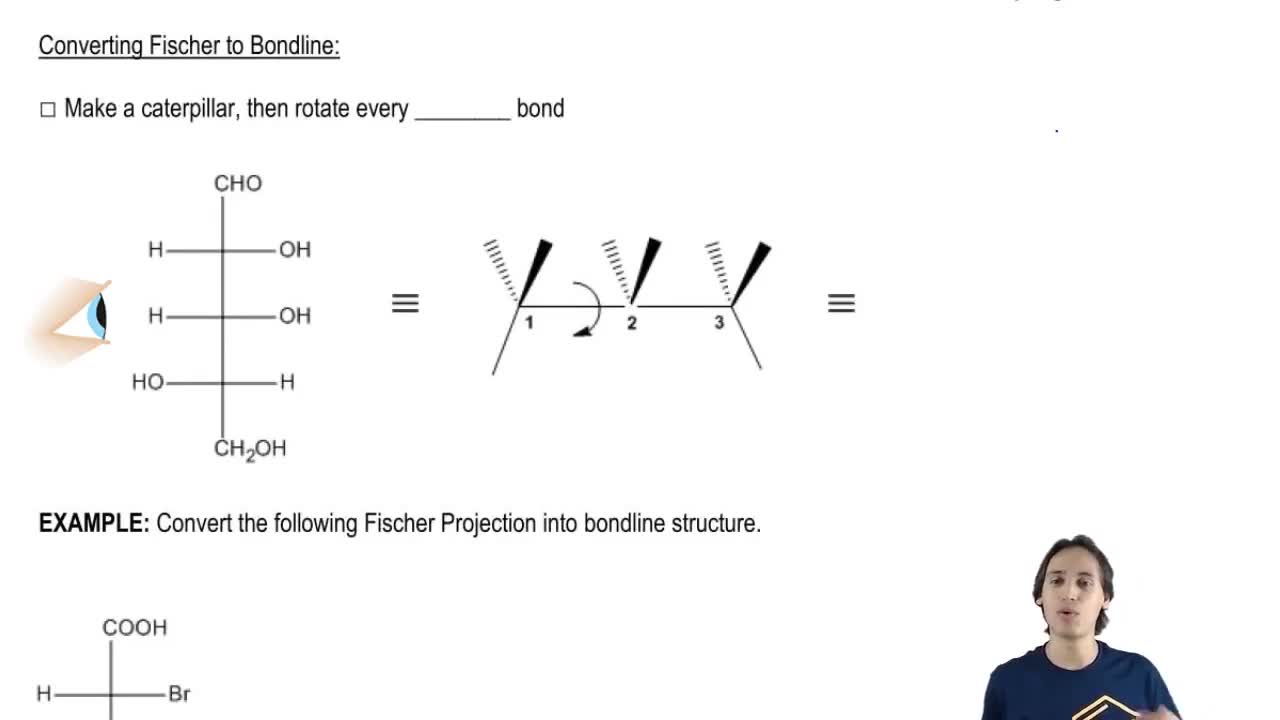
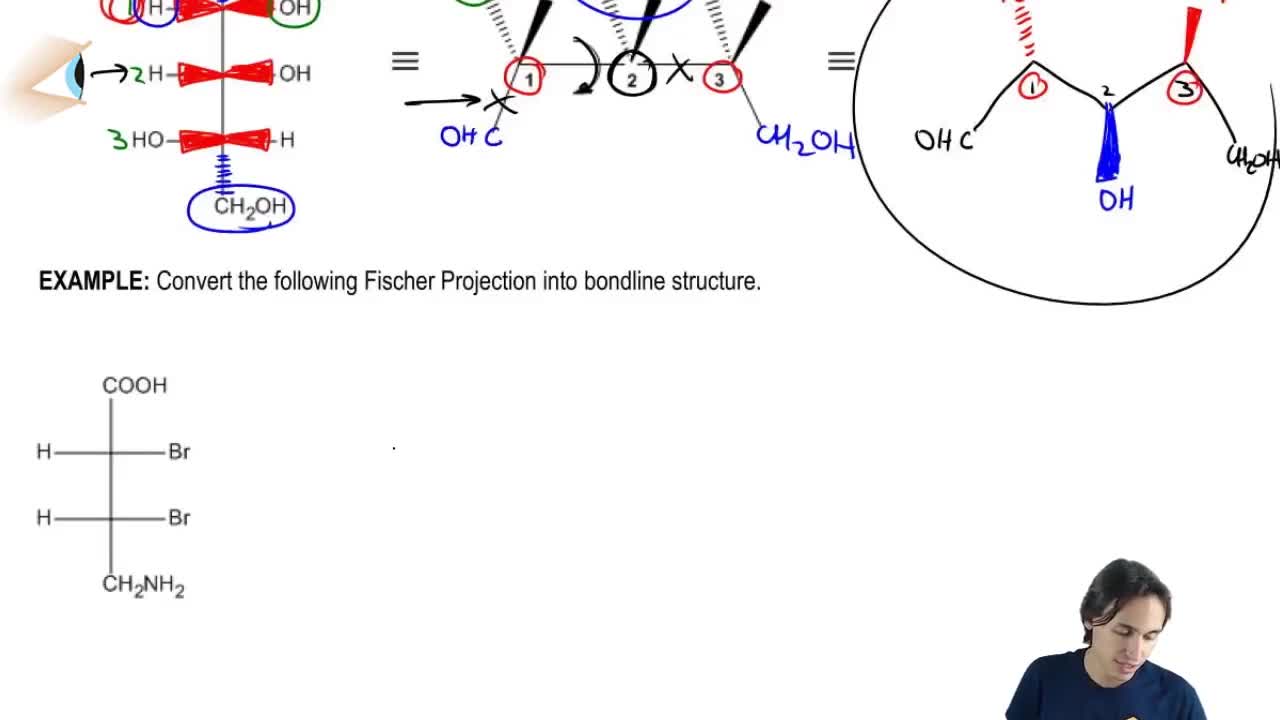
    To convert a Fischer projection into a bond line structure, first interpret the Fischer projection using wedge and dash notation to represent 3D orientation. Visualize the molecule from the side to create a 'caterpillar' view, identifying the spatial arrangement of groups. Then, rotate every other bond (typically every even-numbered atom) to form the zigzag pattern of a bond line structure, ensuring correct placement of groups as per their original orientation.
  • What is the difference between Fischer, Haworth, Newman, and Sawhorse projections in organic chemistry?
    Fischer projections are used mainly for sugars and show 3D orientation in a 2D format. Haworth projections represent cyclic (ring) structures, highlighting top and bottom positions. Newman projections analyze conformations by looking down a bond axis. Sawhorse projections are used for stereochemistry, showing the spatial relationship between atoms.
  • Describe the steps involved in interpreting the spatial arrangement of groups in a Fischer projection.
    In a Fischer projection, vertical bonds go into the page and horizontal bonds come out. To interpret spatial arrangement, redraw the projection with wedge and dash notation, visualize the molecule from the side ('caterpillar' view), and identify which groups are in front (wedges) and which are in back (dashes) for each carbon atom.
  • How do you convert a Fischer projection of a sugar to its Haworth projection (cyclic form)?
    To convert a Fischer projection of a sugar to its Haworth projection, identify the groups on each carbon in the Fischer projection, then form a ring by connecting the appropriate carbon atoms (typically C1 to C5 or C6 for pyranose or furanose forms). Place substituents above or below the ring based on their positions in the Fischer projection: groups on the right go below the ring, and groups on the left go above.
  • What is the purpose of rotating every other bond when converting a Fischer projection to a bond line structure?
    Rotating every other bond (typically every even-numbered atom) when converting a Fischer projection to a bond line structure restores the zigzag pattern typical of bond line structures and ensures the correct spatial arrangement of groups as per their original orientation in the Fischer projection.
  • Why is it important to convert different types of projections into bond line structures before analyzing molecules?
    Bond line structures serve as the standardized format for comparing molecules in organic chemistry. Converting projections to bond line structures ensures consistent analysis and interpretation across different types of molecules.
  • In the process of converting a Fischer projection to a bond line structure, what does the 'caterpillar' visualization help you determine?
    The 'caterpillar' visualization helps you identify the spatial arrangement of groups around each carbon atom by showing which groups are in front and which are in back. This step is crucial for accurately translating the 3D orientation from the Fischer projection to the bond line structure.
  • When rotating every other bond during Fischer to bond line conversion, what happens to the orientation of substituents on the rotated carbon atoms?
    The orientation of substituents on rotated carbon atoms flips, so groups that were in the back move to the front and vice versa. This adjustment restores the zigzag pattern typical of bond line structures while maintaining correct spatial relationships.
  • Is it necessary to draw hydrogen atoms when creating a bond line structure from a Fischer projection, and why?
    No, it is not necessary to draw hydrogen atoms in bond line structures because they are typically omitted for simplicity. The focus is on the connectivity and arrangement of non-hydrogen atoms and functional groups.