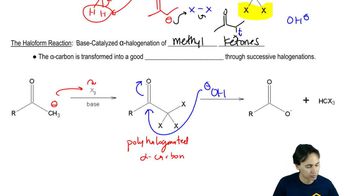
Which types of organic compounds are able to undergo the haloform reaction, and what structural feature is required for this reaction to occur?
Compounds that can undergo the haloform reaction are those containing a methyl group directly attached to a carbonyl carbon, specifically methyl ketones (R-CO-CH3) or compounds that can be oxidized to methyl ketones. The key structural feature required is the presence of a methyl group (–CH3) adjacent to a carbonyl group (C=O), which allows for successive alpha halogenation and eventual formation of a good leaving group (CX3) during the reaction.
What is the role of the base in the haloform reaction mechanism?
The base initiates enolate formation and later deprotonates the carboxylic acid product. It also facilitates the expulsion of the CX3 group by attacking the carbonyl carbon.
Why does the CX3 group act as a good leaving group in the haloform reaction?
The CX3 group is a good leaving group because it contains three electron-withdrawing halogens, making the carbon highly stabilized upon departure. This allows the reaction to proceed through expulsion of CX3−.
What intermediate is formed after the base attacks the polyhalogenated methylketone in the haloform reaction?
A tetrahedral intermediate is formed when the base attacks the carbonyl carbon of the polyhalogenated methylketone. This intermediate contains an O− and a CX3 group attached to the same carbon.
How does the haloform reaction differ from standard base-catalyzed alpha halogenation?
The haloform reaction specifically involves methylketones and leads to complete halogenation of the methyl group, forming a CX3 leaving group. Standard alpha halogenation does not necessarily produce a good leaving group or result in carboxylic acid formation.
What are the final products of the haloform reaction?
The final products are a carboxylate ion and a haloform molecule (CHX3). The haloform's identity depends on the halogen used in the reaction.
How can the haloform reaction be used as a laboratory test for methylketones?
The formation of a yellow precipitate of iodoform (CHI3) indicates the presence of a methylketone. This is a qualitative test commonly used in organic chemistry labs.
What happens to the CX3− ion after it is expelled in the haloform reaction?
The CX3− ion deprotonates the carboxylic acid formed in the reaction. This results in the formation of a carboxylate ion and the neutral haloform molecule.
Why would a base-catalyzed mechanism without a polyhalogenated methyl group not result in expulsion of a leaving group?
Without a polyhalogenated methyl group, the carbon is not a good leaving group and cannot be expelled. The reaction would stall because there is no suitable group to be kicked out by the base.
What structural change occurs to the alpha carbon during the haloform reaction?
The alpha carbon is successively halogenated until it bears three halogen atoms, forming a CX3 group. This transformation makes it a highly effective leaving group in the reaction.