Infrared Spectroscopy quiz #1 Flashcards

Infrared Spectroscopy quiz #1
Control buttons has been changed to "navigation" mode.
1/11
  • How can you use IR spectroscopy to identify a compound based on its IR spectrum?
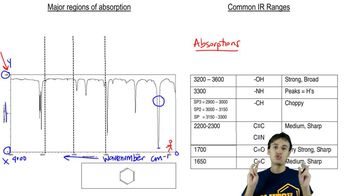
    You can identify a compound using IR spectroscopy by analyzing the positions and shapes of absorption peaks in the functional group region (above 1500 cm⁻¹), which correspond to specific bond vibrations and functional groups. The fingerprint region (below 1500 cm⁻¹) can help distinguish between different molecules, but is less useful for identifying functional groups.
  • Which type of alkene group produces the strongest signal in an IR spectrum, and why?
    The strength of an IR absorption depends on the change in dipole moment during vibration. Alkenes with more polar double bonds or those attached to groups that increase dipole changes will produce stronger IR signals. Generally, more substituted or conjugated alkenes can show stronger absorptions due to increased dipole changes.
  • Which types of molecular vibrations are infrared active and can be detected by IR spectroscopy?
    Vibrations that result in a change in the dipole moment of the molecule are infrared active and can be detected by IR spectroscopy. Symmetrical vibrations that do not change the dipole moment (such as in N₂) are not IR active.
  • How would you interpret the IR spectrum of an unknown compound to determine its functional groups?
    To interpret the IR spectrum of an unknown compound, focus on the functional group region (above 1500 cm⁻¹) and identify characteristic absorption peaks corresponding to specific bonds (e.g., C=O, O-H, N-H, C≡C, C≡N). The presence and position of these peaks help determine which functional groups are present.
  • What are the characteristic IR absorption peaks you would expect to find in the IR spectrum of aspirin?
    In the IR spectrum of aspirin, you would expect to see a strong, sharp absorption around 1700 cm⁻¹ for the C=O (carbonyl) stretch, a broad absorption above 3000 cm⁻¹ for the O-H stretch, and additional peaks in the functional group region for aromatic C-H and C-O stretches.
  • What are the key IR absorption features you would expect in the IR spectrum of dibenzalacetone?
    Dibenzalacetone contains conjugated carbonyl and alkene groups. Its IR spectrum would show a strong absorption near 1700 cm⁻¹ for the C=O stretch, and absorptions in the 1600–1680 cm⁻¹ range for C=C stretches, along with aromatic C-H stretches above 3000 cm⁻¹.
  • What are the main IR absorption peaks expected in the IR spectrum of 3-methyl-1-butanol?
    For 3-methyl-1-butanol, expect a broad O-H stretch above 3200 cm⁻¹, C-H stretches just above 2900 cm⁻¹, and C-O stretches in the functional group region (around 1000–1300 cm⁻¹, though this is near the fingerprint region).
  • What characteristic IR absorption peaks would you expect in the IR spectrum of 2-naphthol?
    2-naphthol would show a broad O-H stretch above 3200 cm⁻¹, aromatic C-H stretches just above 3000 cm⁻¹, and C=C stretches in the 1600–1680 cm⁻¹ range.
  • What are the expected IR absorption peaks for salicylamide?
    Salicylamide would show a strong, sharp C=O stretch near 1700 cm⁻¹, N-H stretches above 3200 cm⁻¹, and possibly a broad O-H stretch if a hydroxyl group is present, along with aromatic C-H and C=C stretches.
  • How can IR spectroscopy be used to monitor the progress of a chemical reaction?
    IR spectroscopy can monitor a reaction by tracking the appearance or disappearance of characteristic absorption peaks corresponding to specific functional groups, indicating the consumption of reactants and formation of products.
  • What are the characteristic IR absorption peaks you would expect in the IR spectrum of triphenylmethanol?
    Triphenylmethanol would show a broad O-H stretch above 3200 cm⁻¹, aromatic C-H stretches just above 3000 cm⁻¹, and C=C stretches in the 1600–1680 cm⁻¹ range.