Why is it best for scientists to use the name from the standardized taxonomic system?
It is best for scientists to use the name from the standardized taxonomic system to ensure consistency and clarity in scientific communication.
2pq represents what genotype?
In the context of population genetics, 2pq represents the frequency of heterozygous individuals in a population under Hardy-Weinberg equilibrium.
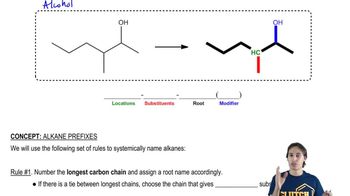
What are the main steps in assigning an IUPAC name to an organic compound?
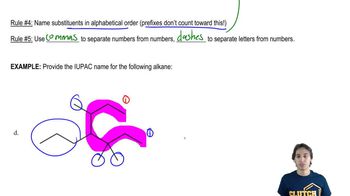
The main steps are: (1) identify the longest continuous carbon chain (parent chain), (2) number the chain from the end nearest a substituent to give the lowest possible locants, (3) identify and name all substituents, (4) assign a number to each substituent based on its position, (5) assemble the name by listing substituents in alphabetical order (ignoring prefixes like di-, tri-, etc.), and (6) use commas to separate numbers and hyphens to separate numbers from letters.
What is a substituent in IUPAC nomenclature?
A substituent is a branch or group attached to the parent chain that is not part of the main chain itself.
How do you number the carbon atoms in the parent chain for IUPAC naming?
Number the chain from the end closest to the first substituent to give the substituents the lowest possible numbers. If there is a tie, use the next substituent or alphabetical order to decide.
How are multiple identical substituents indicated in IUPAC names?
Use prefixes such as di-, tri-, and tetra- to indicate two, three, or four identical substituents, respectively.
How are numbers and letters separated in IUPAC names?
Numbers are separated from each other by commas, and numbers are separated from letters by hyphens.
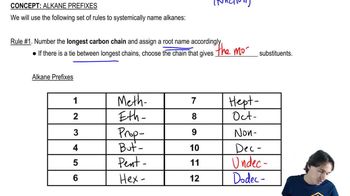
What is the IUPAC prefix for a two-carbon parent chain?
The prefix for a two-carbon chain is 'eth-'.
What is the IUPAC prefix for a four-carbon parent chain?
The prefix for a four-carbon chain is 'but-'.
What is the IUPAC prefix for a six-carbon parent chain?
The prefix for a six-carbon chain is 'hex-'.
What is the IUPAC prefix for an eight-carbon parent chain?
The prefix for an eight-carbon chain is 'oct-'.
What is the IUPAC prefix for a ten-carbon parent chain?
The prefix for a ten-carbon chain is 'dec-'.
What is the IUPAC prefix for a twelve-carbon parent chain?
The prefix for a twelve-carbon chain is 'dodec-'.
What is the general format for an IUPAC alkane name?
The general format is: locant(s)-substituent(s)-parent chain.
How do you name a compound with both methyl and ethyl substituents?
Assign locants to each substituent, list them in alphabetical order (ethyl before methyl), and combine with the parent chain name.
How do you name a compound with three identical substituents?
Assign locants to each substituent, use the prefix 'tri-' (e.g., trimethyl), and include the locants in the name (e.g., 2,3,4-trimethylhexane).
How do you choose the correct numbering direction for the parent chain?
Number the chain from the end nearest the first substituent to give the lowest possible locants for all substituents.
What is the IUPAC name for a straight-chain alkane with six carbons?
The IUPAC name is hexane.
How do you name a compound with both alkyl and halogen substituents?
Assign locants to each substituent, list them in alphabetical order (ignoring prefixes), and combine with the parent chain name.
How do you name a compound with multiple functional groups?
Identify the principal functional group for the suffix, number the chain to give it the lowest possible number, and name other groups as substituents with appropriate prefixes.
How do you name a compound with a two-carbon branch?
A two-carbon branch is called an ethyl group. Assign its locant and include 'ethyl' in the name at the appropriate position.
How do you name a compound with a four-carbon branch?
A four-carbon branch is called a butyl group. Assign its locant and include 'butyl' in the name at the appropriate position.
How do you name a compound with multiple different branches?
Assign locants to each branch, list them in alphabetical order, and use appropriate prefixes for identical groups.
How do you name a compound with a double or triple bond?
Identify the longest chain containing the multiple bond, number the chain to give the multiple bond the lowest possible number, and use the suffix -ene for double bonds or -yne for triple bonds.
How do you name a compound with multiple double or triple bonds?
Use the appropriate suffixes (-diene, -triene, -diyne, etc.), assign locants to each multiple bond, and number the chain to give the lowest possible numbers to the multiple bonds.
How do you name a compound with a substituent on a ring structure?
Assign position 1 to the substituent if only one is present, or number the ring to give the lowest possible numbers to all substituents, and list them in alphabetical order.
How do you name a compound with a tert-butyl or sec-butyl group?
Name the group as tert-butyl or sec-butyl, assign its locant, and include it in the name in alphabetical order (ignoring the prefix for alphabetization).
How do you name a compound with a neopentyl group?
Name the group as neopentyl, assign its locant, and include it in the name in alphabetical order.
How do you name a compound with a tert-butyl group?
Name the group as tert-butyl, assign its locant, and include it in the name in alphabetical order (ignoring 'tert-' for alphabetization).
How do you name a compound with a benzyl group?
Name the group as benzyl, assign its locant, and include it in the name in alphabetical order.
How do you name a compound with an amino group?
Name the group as amino, assign its locant, and include it in the name in alphabetical order.
How do you name a compound with an ester group?
Name the alkyl group attached to the oxygen first, then the parent acid with the suffix -oate, and assign locants as needed.
How do you name a compound with an aldehyde group?
Name the parent chain with the suffix -al, number the chain to give the aldehyde group position 1, and name other groups as substituents.
How do you name a compound with a cyano group?
Name the group as cyano, assign its locant, and include it in the name in alphabetical order.
How do you name a compound with a phosphonic acid group?
Name the parent chain with the suffix -phosphonic acid, number the chain to give the phosphonic acid group the lowest possible number, and name other groups as substituents.
How do you name a compound with a chloro substituent?
Name the group as chloro, assign its locant, and include it in the name in alphabetical order.
How do you name a compound with a fluoro substituent?
Name the group as fluoro, assign its locant, and include it in the name in alphabetical order.
How do you name a compound with a polysubstituted benzene ring?
Assign locants to each substituent to give the lowest possible numbers, list substituents in alphabetical order, and use the parent name benzene.
How do you name a compound with a 2-methyl-4-(1-methylethyl)octane structure?
Assign locants to each substituent, name the branches appropriately (e.g., 2-methyl, 4-(1-methylethyl)), and combine with the parent chain name octane.
How do you name a compound with a 3-methylbutyl group attached to an alkane?
Assign the locant for the 3-methylbutyl group, name it as such, and include it in the name in alphabetical order with other substituents.