Markovnikov quiz #1 Flashcards

Markovnikov quiz #1
Control buttons has been changed to "navigation" mode.
1/10
  • What type of reaction conditions result in Markovnikov addition to an unsymmetric alkene?
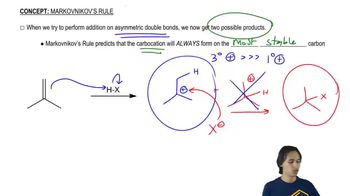
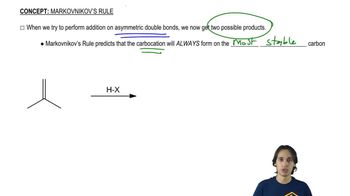
    Markovnikov addition to an unsymmetric alkene occurs under reaction conditions where an electrophile (such as HX, where X is a halide) adds to the alkene, forming a carbocation intermediate. The hydrogen (H) adds to the carbon with more hydrogens (less substituted), and the leaving group (X) attaches to the more substituted carbon, resulting in the most stable carbocation intermediate. This follows Markovnikov's Rule, which states that the carbocation forms at the most stable (usually more substituted) carbon.
  • What is the main purpose of Markovnikov's Rule in addition reactions involving asymmetric alkenes?
    Markovnikov's Rule helps predict which carbon will form the carbocation intermediate during addition reactions. It ensures the carbocation forms at the most stable location, leading to a single major product.
  • Why do asymmetric double bonds lead to the possibility of forming two different products in addition reactions?
    Asymmetric double bonds have different groups on each side, so the electrophile can add to either carbon. This creates two possible carbocation intermediates, but only the most stable one predominates.
  • How do alkyl (R) groups affect the stability of carbocations formed during addition reactions?
    Alkyl groups stabilize carbocations by donating electron density through hyperconjugation and induction. The more alkyl groups attached to the carbocation, the greater its stability.
  • What is the difference in stability between tertiary and primary carbocations in the context of Markovnikov's Rule?
    Tertiary carbocations are much more stable than primary carbocations due to increased alkyl group stabilization. Therefore, the reaction favors formation of the tertiary carbocation intermediate.
  • Why is the shortcut 'the rich get richer' not always a reliable way to apply Markovnikov's Rule?
    This shortcut oversimplifies the rule and may not accurately predict carbocation formation in all cases. The true definition focuses on forming the most stable carbocation, not just adding to the more substituted carbon.
  • What happens to the less stable carbocation intermediate during an addition reaction governed by Markovnikov's Rule?
    The less stable carbocation intermediate does not form to any significant extent. Only the more stable carbocation leads to the observed product.
  • After the carbocation intermediate forms, what is the next step in the reaction mechanism according to Markovnikov's Rule?
    The leaving group (X-) attacks the carbocation to form the final product. This step completes the addition reaction and determines the product's structure.
  • Why is only one product typically observed in Markovnikov addition to asymmetric alkenes?
    Only the most stable carbocation intermediate forms, so the reaction yields a single major product. The less stable alternative is not produced in significant amounts.
  • In Markovnikov addition, why are hydrogens often not explicitly drawn in the final product structure?
    Hydrogens are usually implied unless attached to heteroatoms, so they are omitted for clarity. This convention helps simplify organic structures in reaction mechanisms.