Mass Spectrometry quiz Flashcards

Mass Spectrometry quiz
Control buttons has been changed to "navigation" mode.
1/10
  • What is an advantage of using GC-MS in mass spectrometry?
    GC-MS combines gas chromatography and mass spectrometry, allowing for separation and identification of compounds in complex mixtures with high sensitivity and specificity.
  • What is the most common ionization method in mass spectrometry?
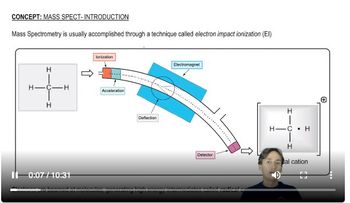
    The most common ionization method in mass spectrometry is electron impact ionization (EI).
  • What is a radical cation in mass spectrometry?
    A radical cation is a molecule that has lost one electron, resulting in a positive charge and a radical state.
  • How does a mass spectrometer detect ions?
    A mass spectrometer detects ions based on their mass-to-charge ratio (m/z), primarily focusing on cations.
  • What does the base peak represent in a mass spectrum?
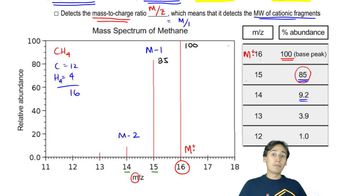
    The base peak represents the tallest peak in a mass spectrum, scaled to 100% relative abundance.
  • Why are smaller ions deflected more easily in a magnetic field?
    Smaller ions are deflected more easily due to their lower inertia compared to larger ions.
  • What does the mass-to-charge ratio (m/z) indicate in mass spectrometry?
    The mass-to-charge ratio (m/z) indicates the molecular weight of cationic fragments, with the charge usually being 1.
  • What is the significance of the molecular ion in mass spectrometry?
    The molecular ion represents the original molecule with one electron missing, indicating its molecular weight.
  • How does fragmentation affect the mass spectrum?
    Fragmentation leads to smaller peaks representing cationic fragments, with detection likelihood decreasing as more atoms are removed.
  • What does the relative abundance on the y-axis of a mass spectrum represent?
    Relative abundance compares the likelihood of detecting a fragment to the base peak, which is scaled to 100%.