Mass Spectrometry quiz #1 Flashcards

Mass Spectrometry quiz #1
Control buttons has been changed to "navigation" mode.
1/10
  • How can the presence of bromine in a compound be identified using its mass spectrum?
    The presence of bromine in a compound can be identified in its mass spectrum by observing two molecular ion peaks of nearly equal intensity separated by 2 mass units. This is due to bromine's two major isotopes, Br-79 and Br-81, which are present in almost equal abundance. The mass spectrum will show a characteristic pattern with these two peaks, indicating the presence of bromine.
  • Why are alpha cleavages common in mass spectrometry for molecules containing heteroatoms?
    Alpha cleavages are common in mass spectrometry for molecules containing heteroatoms because the presence of a heteroatom (such as oxygen, nitrogen, or sulfur) stabilizes the resulting cationic fragment after the bond adjacent (alpha position) to the heteroatom is broken. This stabilization makes alpha cleavage a favored fragmentation pathway, leading to prominent peaks in the mass spectrum.
  • What is the primary purpose of using a mass spectrometer in organic chemistry analysis?
    The primary purpose is to determine the molecular weight of an unknown sample. This helps identify the compound by analyzing its mass spectrum.
  • What is the most common ionization method used in mass spectrometry and how does it work?
    The most common method is electron impact ionization (EI), where high-energy electrons are shot at the sample to knock off an electron. This creates a radical cation from the original molecule.
  • What is a radical cation and how is it formed during mass spectrometry?
    A radical cation is a molecule that has lost one electron, resulting in a positive charge and an unpaired electron. It is formed when high-energy electrons dislodge an electron from the molecule during ionization.
  • How does the mass spectrometer distinguish between ions of different sizes?
    The mass spectrometer uses a magnetic field to deflect ions, with smaller ions being deflected more than larger ones due to their lower inertia. The degree of deflection helps determine the mass of the ions.
  • What does the x-axis and y-axis represent on a typical mass spectrum?
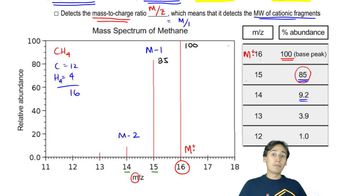
    The x-axis represents the mass-to-charge ratio (m/z), which is usually just the mass since the charge is typically +1. The y-axis shows the relative abundance of each ion compared to the base peak.
  • Why does the molecular ion peak in a mass spectrum have nearly the same mass as the original molecule?
    The molecular ion peak represents the molecule with only one electron missing, and since electrons have negligible mass, the mass remains almost unchanged. Thus, the peak reflects the molecular weight of the original molecule.
  • What is the base peak in a mass spectrum and how is it determined?
    The base peak is the tallest peak in the mass spectrum and is assigned a relative abundance of 100%. All other peaks are scaled relative to the base peak's intensity.
  • Why do peaks corresponding to fragments with more atoms removed tend to be smaller in a mass spectrum?
    It is less probable for a molecule to lose multiple atoms during fragmentation, so peaks for fragments with more atoms removed are less intense. This results in smaller peaks for these less common fragments.