Control buttons has been changed to "navigation" mode.
1/10
Terms in this set (10)
What is another name for the molecular orbital theory of bonding in metals?
Another name for the molecular orbital theory of bonding in metals is the band theory.
Which statement accurately describes molecular orbitals?
Molecular orbitals are formed by the overlap of atomic orbitals and can be either bonding (from constructive interference) or antibonding (from destructive interference), with electrons filling the lowest energy orbitals first according to the Pauli exclusion principle and Aufbau principle.
Which type of molecular orbital would you use to model an electrocyclization reaction using frontier orbital theory?
To model an electrocyclization reaction using frontier orbital theory, you would use the highest occupied molecular orbital (HOMO) and the lowest unoccupied molecular orbital (LUMO) to analyze the interaction of frontier orbitals during the reaction.
How do you draw the molecular orbital (MO) electron diagram for a molecular ion?
To draw the molecular orbital electron diagram for a molecular ion, list the contributing atomic orbitals, show their combination into bonding and antibonding molecular orbitals (using the linear combination of atomic orbitals, LCAO), and fill the resulting molecular orbitals with the total number of electrons present in the ion, starting from the lowest energy orbital and following the Pauli exclusion principle and Hund's rule.
How do you construct an orbital interaction diagram for a molecule?
To construct an orbital interaction diagram, start by drawing the atomic orbitals of the atoms involved, then show how these orbitals combine to form molecular orbitals (both bonding and antibonding) through constructive and destructive interference, and finally fill the molecular orbitals with electrons according to the Aufbau principle and the Pauli exclusion principle.
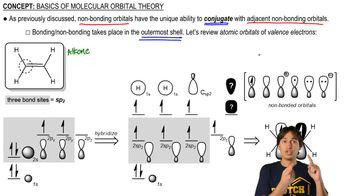
Why are only nonbonding orbitals involved in resonance during conjugation?
Nonbonding orbitals are not attached to other atoms, allowing their electrons to be shared or moved in resonance structures. Bonded orbitals are fixed to atoms and cannot participate in resonance electron movement.
What happens to the electron configuration of carbon during sp2 hybridization?
The 2s orbital blends with two 2p orbitals to form three sp2 hybridized orbitals, distributing electrons more evenly for bonding. One 2pz orbital remains unhybridized and contains a nonbonding electron.
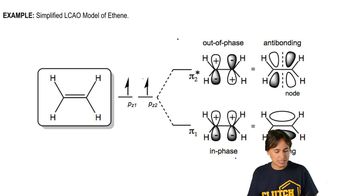
How do atomic orbitals interact to form molecular orbitals according to the LCAO method?
Atomic orbitals overlap and combine as waves, not particles, resulting in constructive or destructive interference. The LCAO method predicts the shape and energy of the resulting molecular orbitals from these overlaps.
What is the significance of a node in a molecular orbital diagram?
A node is a region between atoms where the probability of finding electrons is zero due to destructive interference of atomic orbitals. This leads to an antibonding interaction, making the molecule less stable.
Why do electrons fill bonding molecular orbitals before antibonding ones?
Electrons fill the lowest energy orbitals first according to the Aufbau principle and Pauli exclusion principle. Bonding molecular orbitals are lower in energy and promote stability, while antibonding orbitals are higher in energy and destabilize the molecule.