Back

Monosaccharides - Common Structures quiz #2

Control buttons has been changed to "navigation" mode.
1/31
  • What is the base in ATP made of which type of sugar?

    The base in ATP is made of ribose sugar.
  • Which molecule do plants use to store extra glucose?

    Plants use starch to store extra glucose.
  • Which two monosaccharides combine to form sucrose?

    Glucose and fructose combine to form sucrose.
  • How can glucose and fructose be described in terms of their structural relationship?

    Glucose and fructose can be described as isomers.
  • What aspect of the sugar is unique to RNA?

    RNA contains ribose, which has an OH group on the 2' carbon.
  • What happens to the sugars that are made during photosynthesis?

    The sugars made during photosynthesis are used for energy, growth, and storage in plants.
  • What are complex carbohydrates made of?

    Complex carbohydrates are made of simple sugars.
  • Per molecule of glucose, how many ATP are produced in cellular respiration?

    Per molecule of glucose, up to 38 ATP can be produced in cellular respiration.
  • What type of macromolecule is sugar?

    Sugar is a carbohydrate.
  • Which statement about carbohydrates is false?

    The false statement is that carbohydrates are proteins.
  • What is not a role of carbohydrates?

    Enzyme catalysis is not a role of carbohydrates.
  • What are the functions of starch or chitin?

    Starch functions in energy storage, while chitin provides structural support.
  • What is the storage form of glucose in a plant?

    The storage form of glucose in a plant is starch.
  • What is the difference between starch and glycogen?

    Starch is less branched than glycogen and is used for energy storage in plants.
  • What three-carbon carbohydrate leaves the Calvin cycle and is used to build glucose and sucrose?

    Glyceraldehyde-3-phosphate (G3P) leaves the Calvin cycle and is used to build glucose and sucrose.
  • Which carbohydrate is not a starch?

    Cellulose is not a starch.
  • For what purpose does a plant use the sugars produced during photosynthesis?

    Plants use the sugars produced during photosynthesis for energy, growth, and storage.
  • Which statement about glycogen is false?

    The false statement is that glycogen is found in plants.
  • Which features distinguish between glucose and ribose molecules?

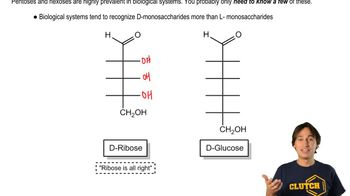
    Glucose is a hexose with six carbons, while ribose is a pentose with five carbons.
  • What happens to the sugar that plants make during photosynthesis?

    The sugar made during photosynthesis is used for energy, growth, and storage in plants.
  • For which organ is glucose most critical as an energy source?

    Glucose is most critical as an energy source for the brain.
  • What is the major difference between glycogen and amylopectin?

    The major difference is that glycogen is more highly branched than amylopectin.
  • How do plants store their extra sugar?

    Plants store their extra sugar as starch.
  • What enzyme breaks down starch?

    Amylase breaks down starch.
  • Sugar is a component of which nucleic acids?

    Sugar is a component of DNA and RNA.
  • What do we get from glucose? (Choose all that apply) Energy, Proteins, Lipids, Nucleic acids

    From glucose, we get energy.
  • How do the hexoses glucose and galactose differ from one another?

    Glucose and galactose differ as C4 epimers, with the OH group at the fourth carbon in different positions.
  • What kind of sugar does RNA have?

    RNA has ribose sugar.
  • What product of the Calvin cycle is used as a precursor in the synthesis of sucrose or starch?

    Glyceraldehyde-3-phosphate (G3P) is used as a precursor in the synthesis of sucrose or starch.
  • Which statement correctly describes starch and cellulose?

    Starch is used for energy storage, while cellulose provides structural support.
  • What sugar does DNA have? RNA?

    DNA has deoxyribose sugar, while RNA has ribose sugar.