Naming Aldehydes quiz #1 Flashcards

Naming Aldehydes quiz #1
Control buttons has been changed to "navigation" mode.
1/10
  • What is the generic structure of an aldehyde functional group?
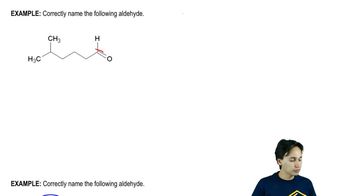
    An aldehyde has a terminal carbonyl group (C=O) bonded to a hydrogen atom and an alkyl or aryl group, with the general structure R-CHO.
  • How can you identify a compound as an aldehyde based on its structure?
    A compound is an aldehyde if it contains a carbonyl group (C=O) at the end of a carbon chain, with the carbonyl carbon bonded to a hydrogen atom.
  • What features distinguish aldehydes from other molecules such as ketones or alcohols?
    Aldehydes have a terminal carbonyl group bonded to a hydrogen, while ketones have an internal carbonyl group bonded to two carbon atoms, and alcohols have a hydroxyl group (-OH) instead of a carbonyl.
  • How do you name a simple aldehyde according to IUPAC nomenclature rules?
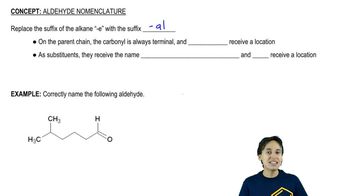
    To name a simple aldehyde, replace the alkane suffix '-e' with '-al' (e.g., ethane becomes ethanal), and no locant is needed since the aldehyde group is always at the end of the chain.
  • How do you classify a molecule as a ketone or an aldehyde based on its line-bond formula?
    If the line-bond formula shows a carbonyl group at the end of the chain bonded to a hydrogen, it is an aldehyde; if the carbonyl group is within the chain bonded to two carbons, it is a ketone.
  • How do you determine whether a structural formula represents a ketone or an aldehyde?
    Examine the placement of the carbonyl group: if it is at the end of the chain and bonded to a hydrogen, it is an aldehyde; if it is within the chain and bonded to two carbons, it is a ketone.
  • Why is it unnecessary to assign a locant to the aldehyde group when naming straight-chain aldehydes?
    The aldehyde group is always at the end of the chain by definition, so its position is implied and does not require a locant. Assigning a locant would be redundant since internal carbonyls are classified as ketones.
  • How does the suffix for naming aldehydes differ from that used for alcohols, and why can this be confusing?
    Aldehydes use the suffix '-al' while alcohols use '-ol', which sound very similar and can be easily confused. Careful pronunciation and attention to spelling are important to distinguish between the two.
  • What special naming convention is used when an aldehyde group is attached as a substituent to a ring structure?
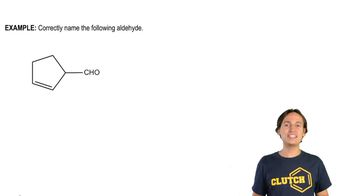
    When an aldehyde is a substituent on a ring, it is named as 'carbaldehyde' and a locant is assigned to indicate its position. This differs from straight-chain aldehydes, which do not require a locant.
  • What happens to the functional group classification if the carbonyl group is located within the carbon chain instead of at the end?
    If the carbonyl group is internal, the compound is classified as a ketone rather than an aldehyde. This is because aldehydes must have a terminal carbonyl group bonded to a hydrogen.