How can you identify an amide among a group of organic compounds based on their structure and naming conventions?
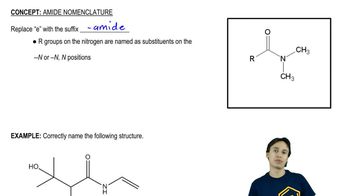
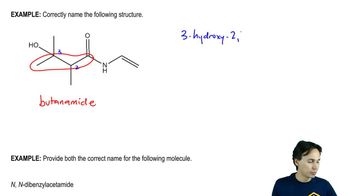
An amide is identified as a carboxylic acid derivative where the carbonyl group (C=O) is directly bonded to a nitrogen atom (N). In naming, amides have names ending with 'amide,' and any alkyl groups attached to the nitrogen are indicated with 'N-' or 'N,N-' prefixes. Unlike esters, amides can have multiple substituents on the nitrogen. Look for a structure with a carbonyl group attached to a nitrogen, and a name ending in 'amide.'
What suffix is used when naming amides derived from carboxylic acids?
The suffix 'amide' replaces the 'e' ending of the parent chain. This indicates the compound is an amide.
How many substituents can be attached to the nitrogen atom in an amide?
Up to three substituents can be attached to the nitrogen atom in an amide. This is because nitrogen can form three bonds.
How are alkyl groups attached to the nitrogen in amides indicated in the name?
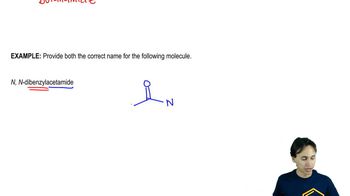
Alkyl groups on the nitrogen are indicated by 'N-' or 'N,N-' prefixes before the substituent name. This shows their attachment to the nitrogen atom.
What is the difference between naming substituents on nitrogen in amides versus esters?
Amides can have multiple substituents on nitrogen, while esters can only have one on oxygen. The naming for amides uses 'N-' prefixes for each substituent.
When naming amides, what should you do if there are multiple methyl groups attached to the nitrogen?
Use 'N,N-dimethyl' to indicate two methyl groups attached to the nitrogen. This prefix comes before the parent chain name ending in 'amide'.
What naming conventions can be used for amides besides IUPAC names?
Both common names and IUPAC names can be used for amides. The choice depends on the context and the specific compound.
How do you indicate the location of substituents in amide naming?
Locations of substituents are described using numbers or Greek letters. This ensures clarity in the structure's description.
Why is naming amides more complex than naming esters?
Naming amides is more complex because nitrogen can have up to three substituents, requiring multiple prefixes. Esters only have one substituent on oxygen, making their naming simpler.
What is the general structure for naming an amide with two methyl groups on nitrogen?
The general structure is 'N,N-dimethyl' followed by the parent chain name ending in 'amide'. This format specifies both the substituents and the parent chain.