What structural feature distinguishes a ketone from other organic compounds?
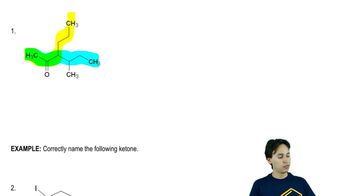
A ketone is characterized by a carbonyl group (C=O) bonded to two carbon atoms. The carbonyl carbon is not at the end of the chain, but is flanked by alkyl or aryl groups on both sides.
How is the IUPAC name of a ketone determined for a straight-chain molecule?
In IUPAC naming, the root name of the carbon chain is modified by replacing the 'e' ending with 'one', and the position of the carbonyl group is specified with a number. For example, a four-carbon chain with a carbonyl group on the second carbon is named 2-butanone.
What is the general method for identifying ketones among a group of molecules?
To identify ketones, look for molecules that contain a carbonyl group (C=O) bonded to two carbon atoms. The carbonyl group should not be at the end of the chain (as in aldehydes), but rather between two alkyl or aryl groups.
What suffix is used to indicate the presence of a ketone in IUPAC nomenclature?
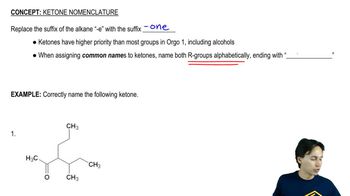
The suffix '-one' is used to indicate a ketone in IUPAC names. It replaces the 'e' at the end of the parent alkane name.
How are the two alkyl groups attached to the carbonyl carbon ordered in the common naming of ketones?
In common naming, the two alkyl groups are listed in alphabetical order before the word 'ketone.' This helps distinguish between different ketones with the same molecular formula.
Why is IUPAC naming preferred over common naming for complex ketones?
IUPAC naming is preferred for complex ketones because common naming becomes impractical with large or branched substituents. The IUPAC system provides a clear and systematic way to name such molecules.
What is the correct pronunciation of the suffix '-one' in ketone names?
The suffix '-one' is pronounced 'own,' not 'one' as in the number. This pronunciation distinguishes it from the numeral.
When both a ketone and an alcohol are present in a molecule, which group takes priority in naming and numbering?
The ketone group takes priority over the alcohol group in both naming and numbering. This means the carbonyl carbon receives the lowest possible number.
For which types of ketones is the common naming system most often used in laboratory settings?
The common naming system is most often used for smaller, simpler ketones typically encountered in laboratory settings. Larger or more complex ketones are usually named using the IUPAC system.
What is a key similarity between the common naming of ketones and ethers?
Both ketones and ethers can be named by listing the substituents in alphabetical order followed by the functional group name. For ketones, this results in names like 'ethyl methyl ketone.'