NMR Spectroscopy quiz #1 Flashcards

NMR Spectroscopy quiz #1
Control buttons has been changed to "navigation" mode.
1/11
  • What would the 1H NMR spectrum of tetramethylsilane (TMS) look like?
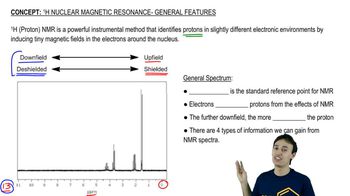
    The 1H NMR spectrum of tetramethylsilane (TMS) would show a single sharp peak at 0 ppm, representing all twelve equivalent protons in the four methyl groups attached to silicon. This peak is highly upfield due to the high electron density (shielding) around the protons.
  • Which solvents are commonly used for acquiring a 1H NMR spectrum?
    Common solvents used for acquiring a 1H NMR spectrum are deuterated solvents such as deuterated chloroform (CDCl3), deuterated dimethyl sulfoxide (DMSO-d6), and deuterated water (D2O). Non-deuterated solvents are generally not used because their protons would interfere with the spectrum.
  • How many distinct peaks would you expect to see in the 13C NMR spectrum of 3-bromohexane?
    In the 13C NMR spectrum of 3-bromohexane, you would expect to see six distinct peaks, corresponding to the six unique carbon environments in the molecule.
  • How would you approach interpreting the 1H NMR spectrum of a compound with the formula C7H14O?
    To interpret the 1H NMR spectrum of a compound with the formula C7H14O, analyze the number of signals (indicating different types of protons), their chemical shifts (to infer functional groups and electronic environments), the integration (relative number of each type of proton), and the splitting patterns (to deduce neighboring protons and structure).
  • What general features would you expect in the 1H NMR spectrum of dibenzalacetone?
    The 1H NMR spectrum of dibenzalacetone would show signals corresponding to aromatic protons (downfield, deshielded), vinylic protons (also downfield), and possibly a singlet for the central methylene group if present. The spectrum would display multiple peaks due to the different environments of the protons.
  • What general features would you expect in the 1H NMR spectrum of triphenylmethanol?
    The 1H NMR spectrum of triphenylmethanol would show aromatic proton signals (downfield, typically 7–8 ppm), and a singlet for the hydroxyl proton (which may be broad and variable), as well as a singlet for the central methine proton attached to the three phenyl groups.
  • What general features would you expect in the 1H NMR spectrum of butyl acetate?
    The 1H NMR spectrum of butyl acetate would show signals for the methyl group of the acetate (singlet, upfield), methylene protons adjacent to the oxygen (downfield), and additional methylene and methyl signals from the butyl chain, each with characteristic splitting patterns based on their neighboring protons.
  • What general features would you expect in the 1H NMR spectrum of acetanilide?
    The 1H NMR spectrum of acetanilide would show aromatic proton signals (downfield), a singlet for the methyl group attached to the nitrogen (upfield), and a singlet or broad peak for the amide NH proton.
  • What general features would you expect in the 1H NMR spectrum of acetophenone?
    The 1H NMR spectrum of acetophenone would show aromatic proton signals (downfield), a singlet for the methyl group attached to the carbonyl (upfield), and splitting patterns reflecting the proximity of the protons to the carbonyl and aromatic ring.
  • How would you approach interpreting the 1H NMR spectrum of a compound with the formula C9H10O2?
    To interpret the 1H NMR spectrum of a compound with the formula C9H10O2, analyze the number and type of signals (aromatic, methyl, methylene, or other functional groups), their chemical shifts, integration, and splitting patterns to deduce the structure and environment of the protons.
  • What general approach should you use to match ethers to their correct 1H NMR spectra?
    To match ethers to their correct 1H NMR spectra, identify the number of unique proton environments, analyze the chemical shifts (especially for protons adjacent to oxygen, which appear downfield), and examine the integration and splitting patterns to correlate with the structure of each ether.