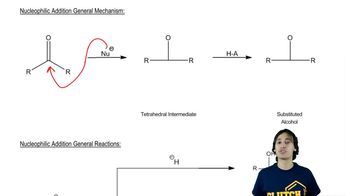
In the nucleophilic addition reaction that forms a bromohydrin product, what is the nucleophile involved?
The nucleophile involved in the formation of a bromohydrin product is typically water (H2O), which attacks the electrophilic carbon after bromine has added to the double bond, resulting in the addition of an -OH group to the molecule.
What is the general product formed when a Grignard reagent is added to an aldehyde in a nucleophilic addition reaction?
When a Grignard reagent (R-MgX) is added to an aldehyde, the nucleophilic R group attacks the electrophilic carbonyl carbon, forming a tetrahedral intermediate. After protonation, the final product is a secondary alcohol with the R group added to the former carbonyl carbon.
What partial charges are present on the carbon and oxygen atoms in a carbonyl group during nucleophilic addition?
The carbon has a partial positive charge and the oxygen has a partial negative charge. This polarization makes the carbon electrophilic and susceptible to nucleophilic attack.
Why is the carbonyl carbon considered electrophilic in nucleophilic addition reactions?
The carbonyl carbon is electrophilic because it carries a partial positive charge due to the electronegativity difference between carbon and oxygen. This makes it attractive to nucleophiles, which are electron-rich species.
What is the name of the intermediate formed immediately after a nucleophile attacks a carbonyl carbon?
The intermediate formed is called a tetrahedral intermediate. It features a negatively charged oxygen and the newly attached nucleophile.
Why can't an R group be easily expelled as a leaving group during nucleophilic addition to a carbonyl?
R groups are poor leaving groups because they do not stabilize a negative charge well. Therefore, the double bond to oxygen is broken instead to accommodate the nucleophile.
What is the final step in the nucleophilic addition mechanism after the tetrahedral intermediate is formed?
The final step is protonation of the negatively charged oxygen atom. This step stabilizes the intermediate and produces a substituted alcohol.
What type of product is formed when a cyanide ion (CN-) acts as the nucleophile in nucleophilic addition to a carbonyl?
The product is a cyano alcohol, which is an alcohol with a cyano group attached to the former carbonyl carbon. This results from the addition of CN- followed by protonation.
How does the geometry of the product change when an alkynide ion is added to a carbonyl compound?
The product features a linear geometry at the site of the triple bond due to sp hybridization. This is a result of the alkynide's triple bond being attached to the former carbonyl carbon.
Why are organometallic compounds like alkynides considered strong nucleophiles in nucleophilic addition reactions?
Organometallic compounds are strong nucleophiles because the carbon bonded to a metal is highly electron-rich. This allows them to readily attack electrophilic carbonyl carbons.