Optical Activity quiz #1 Flashcards

Optical Activity quiz #1
Control buttons has been changed to "navigation" mode.
1/10
  • Why does a racemic mixture not rotate plane-polarized light?
    A racemic mixture contains equal amounts of both enantiomers, which rotate plane-polarized light in opposite directions by equal amounts. The rotations cancel each other out, resulting in no net rotation of plane-polarized light.
  • How can you determine if a compound is optically active or optically inactive?
    A compound is optically active if it is chiral, meaning it cannot be superimposed on its mirror image and lacks a plane of symmetry. Chiral compounds rotate plane-polarized light. In contrast, achiral compounds or racemic mixtures are optically inactive because they do not rotate plane-polarized light.
  • What device is used to measure the rotation of plane-polarized light by chiral molecules?
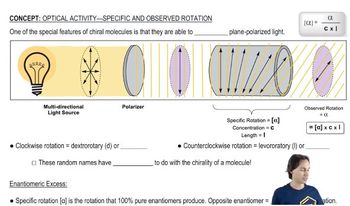
    A polarimeter is used to measure the rotation of plane-polarized light by chiral molecules. It consists of a light source, a polarizer, and a tube containing the chiral sample.
  • What happens to light after it passes through the polarizer in a polarimeter?
    After passing through the polarizer, the light becomes plane-polarized, meaning it oscillates in only one plane. This plane-polarized light is then directed through the sample tube.
  • Which three factors determine the observed rotation in a polarimeter experiment?
    The observed rotation is determined by the specific rotation of the substance, the concentration of the chiral compound, and the length of the tube. These three factors are multiplied together to calculate the observed rotation.
  • How is the specific rotation of a substance calculated if observed rotation, concentration, and tube length are known?
    Specific rotation is calculated by dividing the observed rotation by the product of concentration and tube length. This rearrangement uses basic algebra from the original formula.
  • What does a positive specific rotation indicate about the direction of light rotation?
    A positive specific rotation indicates that the compound is dextrorotary, meaning it rotates plane-polarized light clockwise. This is denoted by a plus sign (+).
  • What is the term for a compound that rotates plane-polarized light counterclockwise, and what symbol is used?
    A compound that rotates plane-polarized light counterclockwise is called levorotary. It is represented by a negative sign (−).
  • Does the sign of specific rotation correlate with the R or S configuration of a chiral center?
    No, the sign of specific rotation does not correlate with the R or S configuration. The direction of light rotation is independent of the absolute configuration of the chiral center.
  • Why does increasing the length of the sample tube in a polarimeter increase the observed rotation?
    Increasing the length of the sample tube gives light more distance to interact with the chiral molecules, resulting in greater rotation. The observed rotation is directly proportional to the tube length.