Back

Oxidizing and Reducing Agents quiz

Control buttons has been changed to "navigation" mode.
1/15
  • What is the main difference between oxidation and reduction in organic chemistry compared to general chemistry?

    In organic chemistry, oxidation and reduction focus on changes in oxygen and hydrogen content, rather than complex equations and quantitative calculations.
  • How is oxidation defined in organic chemistry?

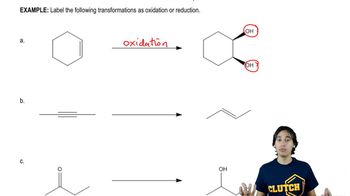
    Oxidation is any reaction that increases the oxygen content or the number of carbon-oxygen bonds in a molecule.
  • What does reduction involve in organic chemistry?

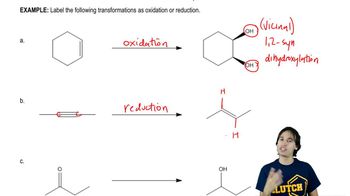
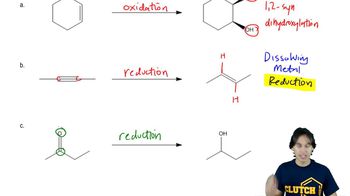
    Reduction involves an increase in the hydrogen content of a molecule.
  • What is the most reduced form of carbon discussed in the lesson?

    Methane (CH4) is the most reduced form of carbon, as it has only bonds to hydrogen and no bonds to oxygen.
  • How does the oxidation state of a primary alcohol compare to methane?

    A primary alcohol is more oxidized than methane because it has one bond to oxygen, while methane has none.
  • Why is an aldehyde more oxidized than an alcohol?

    An aldehyde is more oxidized because its carbon has two bonds to oxygen, compared to one in an alcohol.
  • What functional group is even more oxidized than an aldehyde?

    A carboxylic acid (COOH) is more oxidized than an aldehyde, as it has three bonds to oxygen.
  • What is the fully oxidized form of carbon and why is it considered inorganic?

    The fully oxidized form is carbon dioxide (CO2), which is considered inorganic because it contains no hydrogens.
  • What happens to hydrogen atoms as a molecule becomes more oxidized?

    As a molecule becomes more oxidized, it loses hydrogen atoms and gains more bonds to oxygen.
  • Are oxidation and reduction reactions opposites of each other?

    Yes, oxidation and reduction are opposites; oxidation increases oxygen content, while reduction increases hydrogen content.
  • Which transformations are typically focused on in Organic Chemistry I?

    Organic Chemistry I focuses on transformations between intermediate oxidation states, such as alcohols and aldehydes, not extremes like methane or CO2.
  • Why are methane and CO2 transformations not emphasized in Organic Chemistry I?

    Because Organic Chemistry I deals mainly with functional group transformations, not the conversion of methane to CO2 or vice versa.
  • How can you quickly identify if a reaction is oxidation or reduction in organic chemistry?

    By checking if the molecule gains more bonds to oxygen (oxidation) or gains more hydrogens (reduction).
  • What is the condensed form of the carboxylic acid functional group?

    The condensed form is COOH.
  • What should students practice to master oxidation and reduction in organic chemistry?

    Students should practice identifying oxidation and reduction reactions based on changes in oxygen and hydrogen content.