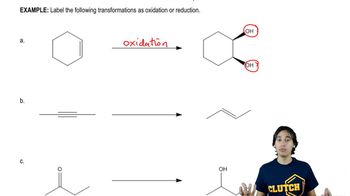
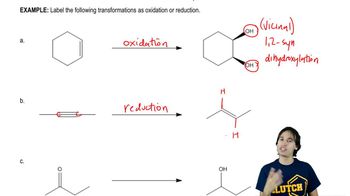
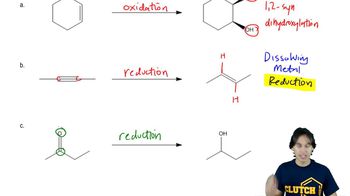
What is the role of a reducing agent in organic chemistry?
A reducing agent donates hydrogen atoms to a molecule, causing an increase in the hydrogen content and resulting in the reduction of that molecule. In other words, it helps convert a more oxidized compound to a more reduced one by increasing its hydrogen content.
How can you determine if a reaction in organic chemistry is an oxidation or a reduction?
You look for an increase in oxygen bonds for oxidation or an increase in hydrogen bonds for reduction. Counting the number of bonds to oxygen and hydrogen on the carbon atom helps identify the type of reaction.
Why is methane considered the most reduced form of carbon in organic chemistry?
Methane has only carbon-hydrogen bonds and no carbon-oxygen bonds. This makes it fully reduced compared to other carbon compounds with more oxygen bonds.
What distinguishes a carboxylic acid from an aldehyde in terms of oxidation state?
A carboxylic acid has three bonds to oxygen, while an aldehyde has two. This means the carboxylic acid is more oxidized than the aldehyde.
Why is CO2 considered inorganic in the context of organic chemistry oxidation states?
CO2 lacks any hydrogen atoms bonded to carbon, which is required for a molecule to be considered organic. Therefore, fully oxidized carbon as CO2 is classified as inorganic.
In organic chemistry 1, which transformations are typically the focus regarding oxidation and reduction?
The focus is on transformations between alcohols and aldehydes. Extreme cases like methane to CO2 are generally not covered in organic chemistry 1.
What happens to the hydrogen content of a molecule as it becomes more oxidized?
The hydrogen content decreases as the molecule gains more bonds to oxygen. This is the opposite of reduction, which increases hydrogen content.
How does the approach to oxidation and reduction in organic chemistry differ from general chemistry?
Organic chemistry emphasizes changes in oxygen and hydrogen bonds rather than complex redox equations. This makes it more qualitative and less math-intensive than general chemistry.
What is the significance of the gray box in the oxidation-reduction chart discussed in the video?
The gray box highlights the compounds and transformations relevant to organic chemistry 1, such as alcohols and aldehydes. It excludes extreme cases like methane and CO2.
Why is it easier to identify oxidation and reduction in organic chemistry compared to general chemistry?
You can simply observe changes in the number of oxygen and hydrogen bonds on the molecule. This visual approach avoids the need for complicated redox equations.