Radical Stability quiz #1 Flashcards

Radical Stability quiz #1
Control buttons has been changed to "navigation" mode.
1/10
  • What factors determine the stability of organic radicals, and which type of radical is generally the most stable?
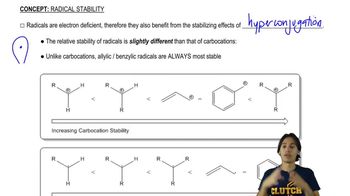
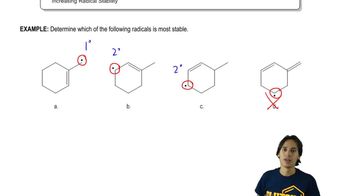
    Radical stability is determined by hyperconjugation and resonance. More alkyl (R) groups around the radical center increase stability via hyperconjugation. However, allylic and benzylic radicals are even more stable due to resonance with adjacent double bonds or benzene rings, which delocalizes the electron deficiency. Therefore, allylic and benzylic radicals are generally the most stable.
  • Why are allylic and benzylic radicals more stable than tertiary alkyl radicals?
    Allylic and benzylic radicals are more stable than tertiary alkyl radicals because their unpaired electron can be delocalized through resonance with adjacent double bonds or benzene rings. This resonance spreads out the electron deficiency over multiple atoms, providing greater stabilization than hyperconjugation alone, which is the main stabilizing effect in tertiary alkyl radicals.
  • Why does the presence of more R groups around a radical center increase its stability?
    More R groups provide greater hyperconjugation, which helps to stabilize the electron-deficient radical center. This effect pushes electron density into the partially filled orbital, making the radical less reactive.
  • How does the stability trend of radicals compare to that of carbocations?
    Both radicals and carbocations are stabilized by hyperconjugation, so their stability trends are similar. However, allylic and benzylic radicals are more stable than tertiary radicals, unlike carbocations.
  • What is the significance of a radical being next to a double bond or benzene ring?
    A radical next to a double bond or benzene ring can participate in resonance, delocalizing the unpaired electron. This delocalization greatly increases the radical's stability.
  • What does it mean for a radical to have a partially filled orbital?
    A partially filled orbital in a radical means it contains only one electron instead of the usual two. This makes the radical electron deficient and highly reactive.
  • Why is resonance more effective than hyperconjugation in stabilizing radicals?
    Resonance allows the unpaired electron to be spread over multiple atoms, reducing electron deficiency more effectively than hyperconjugation. This leads to greater stabilization for allylic and benzylic radicals.
  • How does resonance affect the representation of radicals in structures?
    Resonance means that the radical's electron can be shown in different positions in various resonance structures. The true structure is a hybrid, so stability must be assessed considering all resonance forms.
  • Why is it important to consider all resonance structures when evaluating radical stability?
    Considering all resonance structures ensures you account for the full delocalization of the unpaired electron. This gives a more accurate assessment of the radical's overall stability.
  • How does the Pauli Exclusion Principle relate to the electron configuration of radicals?
    The Pauli Exclusion Principle states that an orbital can hold two electrons, but radicals have only one electron in that orbital. This incomplete filling contributes to their instability.