What are resonance structures and how do they differ from each other?
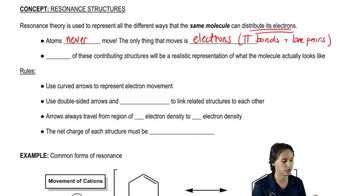
Resonance structures are different ways of distributing electrons (pi bonds and lone pairs) in a molecule without changing the connectivity of atoms. Only electrons move, not atoms.
Which molecules or ions commonly exhibit resonance due to delocalized electrons?
Molecules or ions with conjugated pi systems, adjacent lone pairs and pi bonds, or multiple bonds often exhibit resonance due to delocalized electrons. Examples include carbonate ion, nitrate ion, benzene, and ozone.
What characteristics make a resonance structure a major contributor to the resonance hybrid?
Major contributors are typically neutral, fulfill octet rules, and have charges placed according to electronegativity trends. Structures with complete octets and minimal formal charges are preferred.
How are curved arrows used in drawing resonance structures?
Curved arrows show the movement of electrons from regions of high electron density (lone pairs or pi bonds) to regions of low electron density (positive charges or atoms that can accept electrons).
What is the resonance hybrid and how is it related to contributing resonance structures?
The resonance hybrid is a mathematical blend of all contributing resonance structures, representing the actual electron distribution in the molecule. It combines features of each structure.
Why do atoms not move in resonance structures?
Atoms do not move in resonance structures because resonance only involves redistribution of electrons; the connectivity of atoms remains unchanged.
What is the significance of delocalized electrons in resonance stabilization?
Delocalized electrons allow for multiple resonance structures, which stabilizes the molecule by spreading out electron density and lowering overall energy.
How does the placement of charges affect the stability of resonance structures?
Resonance structures are more stable when negative charges are placed on more electronegative atoms and positive charges on less electronegative atoms.
What is the rule for maintaining net charge across resonance structures?
All resonance structures of a molecule must have the same net charge, as only electron distribution changes, not the number of electrons.
How do resonance structures differ from isomers?
Resonance structures differ only in electron placement, not atom connectivity, while isomers have different atom connectivity.
What is the 'make a bond, break a bond' rule in resonance theory?
When forming a new pi bond in resonance, a corresponding pi bond must be broken to preserve the octet rule, especially when moving electrons from an anion.
How do resonance structures contribute to the actual bonding in a molecule?
The actual bonding is best represented by the resonance hybrid, which averages the electron distributions of all contributing resonance structures.
What types of electrons are involved in resonance structures?
Only pi electrons (from double or triple bonds) and lone pairs are involved in resonance structures.
How can you identify if a molecule exhibits resonance?
A molecule exhibits resonance if it has adjacent pi bonds, lone pairs next to pi bonds, or a conjugated system allowing electron delocalization.
Why are neutral resonance structures generally more stable than charged ones?
Neutral resonance structures are more stable because they minimize formal charges, leading to lower energy and greater stability.
What is the effect of resonance on the stability of carbocations and radicals?
Resonance stabilizes carbocations and radicals by delocalizing the positive charge or unpaired electron over multiple atoms.
How do you determine the most significant resonance structure for a molecule?
The most significant resonance structure is the one that is neutral, fulfills octet rules, and places charges according to electronegativity trends.
What is the role of lone pairs in resonance structures?
Lone pairs can participate in resonance by moving to form pi bonds, contributing to electron delocalization.
How does resonance affect the bond order in molecules?
Resonance causes bond orders to be fractional, as bonds are averaged over multiple resonance structures in the hybrid.
What is the difference between localized and delocalized electrons in resonance?
Localized electrons are confined to one atom or bond, while delocalized electrons are spread over multiple atoms due to resonance.
How do you use curved arrows to show electron movement in resonance structures?
Curved arrows start at a lone pair or pi bond and point toward an atom or bond where electrons are moving, indicating redistribution of electron density.
What is the importance of the octet rule in evaluating resonance structures?
Resonance structures that satisfy the octet rule for all atoms are more stable and contribute more to the resonance hybrid.
How do you identify delocalized electrons in a molecule?
Delocalized electrons are those involved in pi bonds or lone pairs adjacent to pi systems, allowing for resonance.
What is the effect of resonance on the physical properties of molecules?
Resonance can affect bond lengths, bond strengths, and overall stability, often leading to intermediate properties between contributing structures.
How do you determine if a lone pair is localized or delocalized in a compound?
A lone pair is delocalized if it can participate in resonance by moving to form a pi bond; otherwise, it is localized.
What is the significance of double-sided arrows between resonance structures?
Double-sided arrows indicate that the structures are resonance forms, not in equilibrium, but representations of electron delocalization.
How does resonance stabilization occur in anions?
Resonance stabilization in anions occurs when the negative charge is delocalized over multiple atoms through pi bonds and lone pairs.
What is the general process for drawing resonance structures?
Identify possible electron movements (pi bonds and lone pairs), use curved arrows to show movement, ensure octet rules are followed, and maintain net charge.
How does resonance affect the reactivity of organic molecules?
Resonance can stabilize reactive intermediates (like carbocations, radicals, and anions), making reactions more favorable.
What is the role of electronegativity in determining the best resonance structure?
Negative charges are best placed on more electronegative atoms, and positive charges on less electronegative atoms, for greater stability.
How do resonance structures explain the properties of aromatic compounds?
Aromatic compounds have delocalized pi electrons over a ring, leading to resonance stabilization and unique chemical properties.
What is the effect of resonance on the formal charge distribution in a molecule?
Resonance can distribute formal charges over multiple atoms, reducing charge concentration and increasing stability.
How do you identify resonance contributors for a given molecule?
Resonance contributors are identified by moving pi electrons and lone pairs to create alternative electron distributions without changing atom connectivity.
What is the significance of resonance in the carbonate ion?
The carbonate ion has three equivalent resonance structures, with the negative charge delocalized over all three oxygen atoms, leading to equal bond lengths.
How does resonance affect the structure of the nitrate ion?
The nitrate ion has three resonance structures, with the negative charge delocalized over the three oxygen atoms, resulting in equal N–O bond lengths.
What is the meaning of the term 'delocalization' in resonance theory?
Delocalization refers to the spreading of electrons (pi bonds and lone pairs) over multiple atoms, rather than being confined to a single atom or bond.
How do resonance structures contribute to the stability of the ozone molecule?
Ozone has resonance structures that delocalize the negative charge and double bonds over the three oxygen atoms, increasing stability.
What is the importance of resonance in organic reaction mechanisms?
Resonance explains the stability of intermediates and the movement of electrons during reactions, guiding the prediction of products.
How do you determine if a molecule like HCN has resonance structures?
HCN does not have resonance structures because there are no adjacent pi bonds or lone pairs that can be delocalized.
Why does CCl4 not exhibit resonance?
CCl4 does not exhibit resonance because it lacks pi bonds or lone pairs adjacent to pi systems; all bonds are single and localized.