Resonance Structures quiz #2 Flashcards

Resonance Structures quiz #2
Control buttons has been changed to "navigation" mode.
1/22
  • How do you draw resonance structures for a molecule with a lone pair adjacent to a pi bond?
    Move the lone pair to form a pi bond and shift the existing pi bond to an adjacent atom, ensuring octet rules are followed.
  • What is the effect of resonance on the structure of the formate ion?
    The formate ion has two resonance structures, with the negative charge delocalized between the two oxygen atoms, resulting in equal C–O bond lengths.
  • How do resonance structures affect the bond lengths in molecules like benzene?
    Resonance causes all C–C bonds in benzene to be equal in length, intermediate between single and double bonds.
  • How do you identify the resonance hybrid for a compound?
    The resonance hybrid is drawn by combining features of all resonance contributors, showing partial bonds and charges where electrons are delocalized.
  • What is the process for drawing resonance structures for the carbonate ion?
    Move the pi bond between carbon and one oxygen to another oxygen, creating three equivalent structures with the negative charge delocalized.
  • How do you determine if a radical can be stabilized by resonance?
    A radical is stabilized by resonance if the unpaired electron can be delocalized over adjacent pi bonds or atoms.
  • What is the significance of resonance in the nitryl fluoride molecule (NO2F)?
    NO2F has resonance structures with the negative charge and double bonds delocalized over the two oxygen atoms, increasing stability.
  • How do you draw resonance structures for maleic anhydride?
    Move pi electrons between the carbonyl groups and the central oxygen, creating structures with delocalized electrons and charges.
  • How do you identify valid resonance structures for a given molecule?
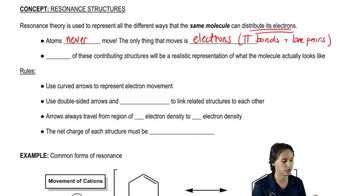
    Valid resonance structures must have the same atom connectivity, maintain net charge, and follow the octet rule.
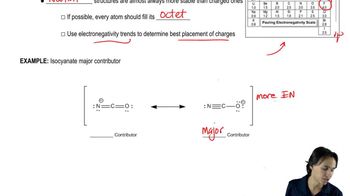
  • What is the effect of resonance on the structure of the CNO– ion?
    CNO– has resonance structures with the negative charge delocalized between the nitrogen and oxygen atoms, and the most stable form places the negative charge on the more electronegative atom.
  • How do you draw resonance structures for the SO3^2– ion?
    Move the pi bond between sulfur and one oxygen to another oxygen, creating equivalent structures with the negative charge delocalized.
  • How do you determine which resonance structure contributes most to the hybrid for SO3^2–?
    The most significant resonance structure for SO3^2– is the one where all atoms fulfill their octet and negative charges are placed on oxygen atoms.
  • How do you draw resonance structures for the S2O molecule?
    Move pi electrons between the sulfur atoms and oxygen, creating structures with delocalized electrons and charges.
  • How do you draw resonance structures for the SeO2 molecule?
    Move pi electrons between selenium and oxygen atoms, creating structures with delocalized electrons and charges.
  • How do you draw resonance structures for the CH3N3 molecule?
    Move pi electrons and lone pairs among the nitrogen atoms, creating structures with delocalized charges and bonds.
  • How do you draw resonance structures for methyl isocyanate?
    Move pi electrons between the nitrogen and oxygen atoms, creating structures with delocalized charges and bonds.
  • How do you draw resonance structures for HCONH2 (formamide)?
    Move the lone pair from the nitrogen to form a pi bond with the carbon, and shift the pi bond from the carbonyl to the oxygen, creating delocalized structures.
  • How do you identify a pair of resonance structures for a given molecule?
    A pair of resonance structures have the same atom connectivity but differ in the placement of pi electrons and/or lone pairs.
  • How do you determine if a compound does not exhibit resonance?
    A compound does not exhibit resonance if it lacks adjacent pi bonds or lone pairs that can be delocalized.
  • How do you draw a resonance structure that places a pi bond in a molecule?
    Move a lone pair to form a pi bond between adjacent atoms, ensuring the octet rule is not violated.
  • How do you identify all resonance structures for a radical species?
    Move the unpaired electron and pi electrons to adjacent atoms, creating alternative structures with delocalized radicals.
  • How do you draw resonance structures for a carbocation intermediate?
    Move pi electrons from adjacent double bonds toward the carbocation, delocalizing the positive charge over multiple atoms.