Wittig Reaction quiz #1 Flashcards

Wittig Reaction quiz #1
Control buttons has been changed to "navigation" mode.
1/10
  • How does the Wittig reaction allow for the regiospecific synthesis of alkenes from aldehydes or ketones, and what is the general process for predicting the alkene product formed?
    The Wittig reaction enables the regiospecific synthesis of alkenes by reacting an aldehyde or ketone with a phosphorus ylide. This reaction forms a new carbon-carbon double bond, allowing precise control over the placement of R groups on the resulting alkene. To predict the alkene product, align the phosphorus atom of the ylide with the oxygen atom of the carbonyl compound, visualize the new double bond forming between the ylide carbon and the carbonyl carbon, and combine the R groups from both reactants across the double bond. The reaction is not stereospecific, so both E and Z isomers may form if possible.
  • What is the role of butyllithium in the formation of a Wittig ylide?
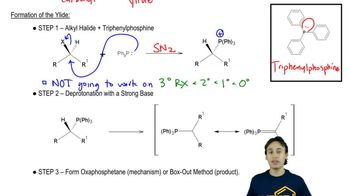
    Butyllithium acts as a strong base to deprotonate the phosphorus compound, generating a ylide with adjacent positive and negative charges. This step is crucial for preparing the reactive species needed for the Wittig reaction.
  • Why does the SN2 reaction used to form the Wittig ylide not work well with tertiary alkyl halides?
    Tertiary alkyl halides are too sterically hindered for the backside attack required in SN2 reactions. As a result, the formation of the ylide is inefficient or fails with these substrates.
  • What is the name of the tetrahedral intermediate formed after nucleophilic addition in the Wittig reaction mechanism?
    The tetrahedral intermediate is called a betaine. In this structure, the positive and negative charges are not adjacent to each other.
  • What structural feature defines an ylide in the context of the Wittig reaction?
    An ylide is characterized by having adjacent positive and negative charges on the same molecule. This unique arrangement is essential for its reactivity in the Wittig reaction.
  • What is the four-membered ring intermediate called in the Wittig reaction mechanism?
    The four-membered ring intermediate is called an oxaphosphetane. It forms after the betaine intermediate and precedes the final alkene product.
  • How does the Wittig reaction differ from typical alkene-forming elimination reactions in terms of product control?
    The Wittig reaction allows precise control over the placement of R groups on the alkene, making it regiospecific. In contrast, elimination reactions often yield mixtures with less control over alkene substitution.
  • What happens to the phosphorus-containing byproduct formed during the Wittig reaction?
    The phosphorus-containing byproduct, typically triphenylphosphine oxide, is not important for the main reaction outcome. It remains in solution and is usually ignored in product analysis.
  • Why might you need to draw both E and Z isomers when predicting Wittig reaction products?
    The Wittig reaction is not stereospecific, so both E and Z alkene isomers can form if possible. You should depict both isomers unless the reaction conditions or substrate restrict the outcome.
  • What is the 'box out' method used for in the Wittig reaction?
    The 'box out' method is a shortcut for predicting the alkene product by aligning the phosphorus of the ylide and the oxygen of the carbonyl, then visualizing the new double bond. It allows students to quickly determine the product without drawing the full mechanism.