Skip to main content
Organic Chemistry
My Course
Learn
Exam Prep
AI Tutor
Study Guides
Textbook Solutions
Flashcards
Explore
Try the app
My Course
Learn
Exam Prep
AI Tutor
Study Guides
Textbook Solutions
Flashcards
Explore
Try the app
Back
chapter 8
You can tap to flip the card.
What is an addition reaction in alkenes?
You can tap to flip the card.
👆
What is an addition reaction in alkenes?
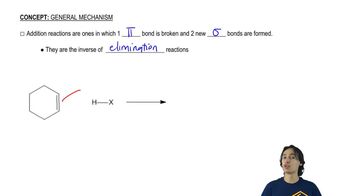
An addition reaction converts a
pi bond
into a
sigma bond
, opposite of elimination.
Track progress
Control buttons has been changed to "navigation" mode.
1/20
Recommended videos
01:15
Provide the mechanism
5716
views
166
rank
8
comments
05:39
Features of Addition Mechanisms.
7383
views
135
rank
15
comments
Terms in this set (20)
Hide definitions
What is an addition reaction in alkenes?
An addition reaction converts a
pi bond
into a
sigma bond
, opposite of elimination.
Why are pi bonds more reactive than sigma bonds in addition reactions?
Pi bonds act as
Lewis bases
(nucleophiles or Brønsted-Lowry bases) because their electrons are more exposed and reactive.
What is the relationship between addition and elimination reactions?
Addition is the reverse of elimination, and often these processes exist in
equilibrium
.
What determines the regiochemistry in electrophilic addition to asymmetrical alkenes?
Markovnikov's Rule: The electrophile adds to the
less substituted carbon
, and the proton adds to the carbon with more hydrogens.
What is the rate-determining step in hydrohalogenation?
The formation of the
carbocation intermediate
is the rate-determining step.
What causes carbocation rearrangements during addition reactions?
Hydride or methyl shifts occur to form a
more stable carbocation
intermediate.
What is Anti-Markovnikov addition and when does it occur?
Anti-Markovnikov addition occurs in the presence of
peroxides (ROOR)
, leading to the electrophile adding to the more substituted carbon.
Describe the acid-catalyzed hydration of alkenes.
Water adds across the double bond with acid catalysis, forming an
oxonium ion intermediate
followed by nucleophilic attack by water.
What is hydroboration-oxidation and its regioselectivity?
Hydroboration-oxidation adds water
anti-Markovnikov
, with OH adding to the less substituted carbon.
What is the stereochemistry of catalytic hydrogenation of alkenes?
Catalytic hydrogenation adds H2
syn
across the double bond, often using metal catalysts like Pt.
What is the mechanism of halogenation of alkenes?
Halogenation proceeds via a
bromonium ion intermediate
and results in
anti addition
of halogens.
How are halohydrins formed from alkenes?
Halohydrins form when halogens add to alkenes in
water solvent
, with water attacking the bromonium ion to add OH.
What determines the regioselectivity in halohydrin formation?
The OH group adds to the
more substituted carbon
due to nucleophilic attack on the bromonium ion.
What is anti dihydroxylation and how is it achieved?
Anti dihydroxylation adds two OH groups
anti
via an epoxide intermediate followed by acid-catalyzed ring opening.
What is syn dihydroxylation and common reagents?
Syn dihydroxylation adds two OH groups
syn
in one step using reagents like OsO4 or cold KMnO4.
What is ozonolysis in alkene chemistry?
Ozonolysis cleaves C=C bonds oxidatively using ozone, producing carbonyl compounds.
What are common reducing agents used after ozonolysis?
Dimethyl sulfide and Zn/H2O are common reducing agents to convert ozonides to carbonyl products.
What is the role of the bromonium ion in halogenation?
The bromonium ion is a three-membered ring intermediate that prevents carbocation formation and leads to anti stereochemistry.
Why does water attack the bromonium ion instead of Br- in halohydrin formation?
Water is a better nucleophile under these conditions and attacks the more substituted carbon of the bromonium ion.
What is the stereochemical outcome of halogen addition to alkenes?
Halogen addition occurs with
anti stereochemistry
, adding to opposite faces of the double bond.
 BackBack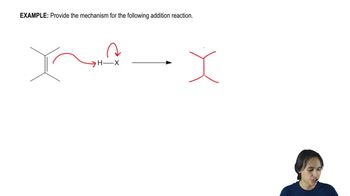
 01:15
01:15