 Back
BackCommon Names of Unsaturated Heterocycles
 03:21
03:21
Terms in this set (20)
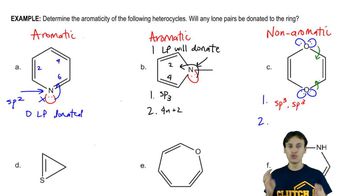
Pyrrole is the common name for a five-membered unsaturated heterocycle containing one nitrogen atom.
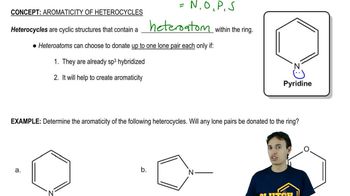
Pyridine is the six-membered unsaturated heterocycle containing one nitrogen atom.
Furan is the five-membered unsaturated heterocycle containing one oxygen atom.
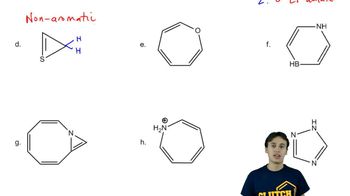
Thiophene is the five-membered unsaturated heterocycle containing one sulfur atom.
Oxazine is a six-membered unsaturated heterocycle containing one nitrogen and one oxygen atom.
Thiazine is a six-membered unsaturated heterocycle containing one nitrogen and one sulfur atom.
Indole is a bicyclic unsaturated heterocycle with a benzene ring fused to a pyrrole ring.
Benzofuran is a bicyclic unsaturated heterocycle with a benzene ring fused to a furan ring.
Benzothiophene is a bicyclic unsaturated heterocycle with a benzene ring fused to a thiophene ring.
An unsaturated heterocycle is a cyclic compound containing at least one heteroatom and one or more double bonds within the ring.
Common heteroatoms include nitrogen (N), oxygen (O), and sulfur (S).
Heteroatoms influence electronic properties, reactivity, and aromaticity of the ring.
All three are aromatic due to conjugated pi electrons and planar ring structure.
They serve as building blocks in pharmaceuticals, agrochemicals, and materials due to their unique properties.
Pyrrole is unsaturated and aromatic; pyrrolidine is saturated and non-aromatic.
Pyrimidine is a six-membered unsaturated heterocycle with two nitrogen atoms at positions 1 and 3.
Imidazole is a five-membered unsaturated heterocycle with two nitrogen atoms.
They are named by adding the prefix benzo- to the heterocycle name, e.g., benzofuran.
Position affects reactivity, electronic distribution, and nomenclature.
Oxazole is a five-membered unsaturated heterocycle containing one oxygen and one nitrogen atom.