 Back
BackElectrophilic Aromatic Substitution in Organic Chemistry
 06:52
06:52
Terms in this set (16)
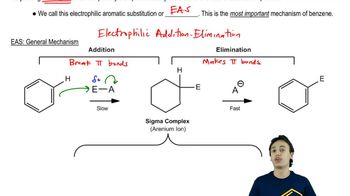
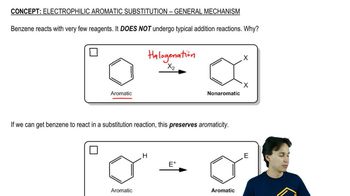
EAS is a reaction where an aromatic ring reacts with an electrophile, replacing a hydrogen atom on the ring.
Sulfonation introduces a sulfonic acid group (-SO3H) onto an aromatic ring using \(\mathrm{SO_3}\\) and \(\mathrm{H_2SO_4}\\).
The -OCH3 group is an electron-donating activating group that directs substitution to the ortho and para positions.
The major product is para-methoxybenzenesulfonic acid, with the -SO3H group para to the -OCH3 group due to less steric hindrance.
The -CO2H group is electron-withdrawing and deactivates the ring, directing bromination to the meta position.
The major product is meta-bromobenzoic acid, with bromine at the meta position relative to the -CO2H group.
The -OCH2Ph group is an activating, ortho/para-directing substituent, favoring bromination at these positions.
The major product is para-bromobenzyl phenyl ether, with bromine at the para position to the -OCH2Ph group.
Friedel-Crafts alkylation introduces an alkyl group onto an aromatic ring using an alkyl halide and AlCl3 as a catalyst.
The -OCH2Ph group activates the ring and directs alkylation to the ortho and para positions.
The major product is para-ethylbenzyl phenyl ether, with the ethyl group at the para position to the -OCH2Ph group.
Nitration introduces a nitro group (-NO2) onto an aromatic ring using \(\mathrm{HNO_3}\\) and \(\mathrm{H_2SO_4}\\).
Both are activating, ortho/para-directing groups that influence the nitro group to add ortho or para to them.
The nitro group adds at a position ortho to the ethyl group and para to the ethoxy group, favored by combined directing effects.
The -OCH3 group activates the ring and directs nitration to the ortho and para positions, with para favored due to less steric hindrance.
The nitro group is introduced at the para position relative to the -OCH3 group on the biphenyl ring.