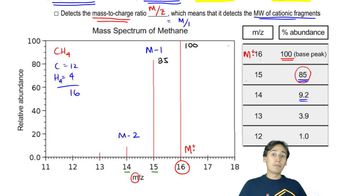
What is the molecular ion (M+) peak in mass spectrometry?
The molecular ion peak corresponds to the intact molecule ionized by loss of one electron, representing the molecular weight of the compound.
What does the M+1 peak in a mass spectrum indicate?
The M+1 peak arises from isotopic variants, mainly due to the presence of \(^{13}C\) atoms in the molecule.
How can isotopes like Cl and Br be identified in mass spectra?
Chlorine and bromine show characteristic isotope patterns with M and M+2 peaks of roughly 3:1 for Cl and 1:1 for Br due to their natural isotopic abundances.
What is alpha cleavage in mass spectrometry?
Alpha cleavage is fragmentation adjacent to a heteroatom, producing two daughter ions, often a resonance-stabilized carbocation and a radical.
How does mass spectrometry differentiate isotopomers?
Mass spectrometry detects isotopomers as separate peaks differing by 1 or 2 mass units, reflecting isotopic substitutions like \(^{13}C\) or \(^{37}Cl\).
What is the base peak in a mass spectrum?
The base peak is the most intense peak in the spectrum, set to 100% abundance, often corresponding to the most stable fragment ion.
Why do alcohols often show an M-18 peak in mass spectrometry?
Alcohols commonly lose a water molecule (H2O, 18 amu) during fragmentation, producing an M-18 peak.
What information does IR spectroscopy provide about molecules?
IR spectroscopy identifies functional groups by measuring vibrational transitions of bonds, showing characteristic absorption frequencies.
What causes broad O-H and N-H stretching bands in IR spectra?
Hydrogen bonding causes broadening of O-H and N-H stretching bands in IR spectra.
What is the typical IR absorption range for carbonyl (C=O) groups?
Carbonyl groups absorb strongly around 1700 cm-1, with exact frequency depending on the functional group.
How does Hooke's law relate to IR vibrational frequencies?
Hooke's law relates vibrational frequency to bond strength and reduced mass; stronger bonds and lighter atoms vibrate at higher frequencies.
What is the fingerprint region in an IR spectrum?
The fingerprint region (below ~1500 cm-1) contains complex absorption patterns unique to each molecule, useful for identification.
What is nuclear spin and how does it relate to NMR spectroscopy?
Nuclei with odd numbers of protons or neutrons have spin, which aligns with or against a magnetic field, enabling resonance absorption in NMR.
Why are deuterated solvents used in NMR experiments?
Deuterated solvents contain \(^{2}H\) which is NMR inactive, preventing solvent signals from interfering with sample spectra.
What determines the number of signals in a 1H NMR spectrum?
The number of signals equals the number of chemically distinct proton environments in the molecule.
What does the area under a 1H NMR signal represent?
The area under a 1H NMR peak is proportional to the relative number of protons in that chemical environment.
What causes splitting patterns in 1H NMR spectra?
Splitting arises from spin-spin coupling with neighboring protons, indicating the number of adjacent hydrogens.
What is chemical shift in NMR spectroscopy?
Chemical shift is the resonance frequency of a nucleus relative to a standard, influenced by the electronic environment.
How does molecular symmetry affect the number of NMR signals?
Symmetry can make chemically equivalent protons produce fewer signals, reducing the total number of distinct peaks.
What is the NMR timescale and its significance?
The NMR timescale (~1 second) determines if dynamic processes like conformational changes are averaged or resolved in the spectrum.
 Back
Back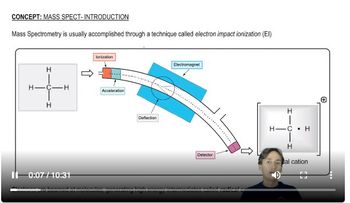
 10:48
10:48