 Back
BackStepwise Mechanism for Epoxide Ring Opening with Nucleophile
Study Guide - Smart Notes
 Tailored notes based on your materials, expanded with key definitions, examples, and context.
Q2. Draw the curved arrow mechanism for the reaction below. You do not need to show stereochemistry.
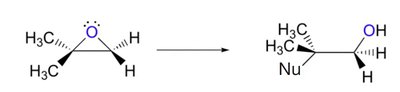
Background
Topic: Epoxide Ring Opening (Nucleophilic Addition)
This question tests your understanding of the mechanism by which a nucleophile opens an epoxide ring, resulting in the formation of an alcohol and the addition of the nucleophile to the adjacent carbon.
Key Terms and Formulas
Epoxide: A three-membered cyclic ether, highly strained and reactive toward nucleophiles.
Nucleophile (Nu): A species that donates an electron pair to form a new covalent bond.
Curved Arrow Mechanism: Shows the movement of electron pairs during the reaction.
Step-by-Step Guidance
Identify the epoxide as the electrophile and the nucleophile (Nu) as the attacking species.
Recognize that the nucleophile will attack one of the carbons in the epoxide ring, leading to ring opening. The attack typically occurs at the less hindered carbon in basic conditions.
Draw a curved arrow from the nucleophile to the carbon being attacked, and another curved arrow from the epoxide C–O bond to the oxygen atom, showing the ring opening.
After the ring opens, the oxygen atom will bear a negative charge (as an alkoxide). In a subsequent step, this alkoxide is protonated (by water or another proton source) to yield the alcohol.
Try solving on your own before revealing the answer!
Final Answer:
The nucleophile attacks the less hindered carbon of the epoxide, opening the ring. The oxygen is then protonated to form the alcohol. The mechanism involves two main steps: nucleophilic attack and protonation.
Curved arrows should show: (1) Nu attacking the epoxide carbon, (2) epoxide bond breaking to oxygen, (3) proton transfer to oxygen.
