 Back
BackThe Periodic Table of the Elements: Foundation for Organic Chemistry
Study Guide - Smart Notes
 Tailored notes based on your materials, expanded with key definitions, examples, and context.
The Periodic Table of the Elements
Introduction to the Periodic Table
The periodic table is a systematic arrangement of all known chemical elements, organized by increasing atomic number and recurring chemical properties. It serves as a foundational tool in chemistry, including organic chemistry, for understanding the behavior of elements and predicting their interactions.
Groups (Columns): Elements in the same group have similar chemical properties due to their valence electron configurations.
Periods (Rows): Elements in the same period have the same number of electron shells.
Main Group Elements: Groups 1, 2, and 13-18 are especially important in organic chemistry, as they include hydrogen, carbon, nitrogen, oxygen, and the halogens.
Transition Metals: Found in groups 3-12, these elements are less commonly encountered in introductory organic chemistry but are important in advanced topics such as organometallic chemistry.
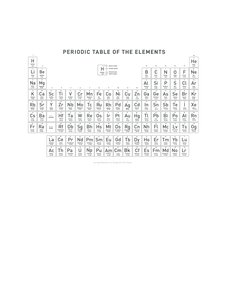
Key Elements in Organic Chemistry
Organic chemistry primarily focuses on compounds containing carbon (C), but also involves other elements such as hydrogen (H), oxygen (O), nitrogen (N), sulfur (S), phosphorus (P), and the halogens (fluorine, chlorine, bromine, iodine).
Carbon (C): The central element in organic compounds, capable of forming four covalent bonds and a variety of structures (chains, rings, etc.).
Hydrogen (H): The most common atom bonded to carbon in organic molecules.
Oxygen (O) and Nitrogen (N): Commonly found in functional groups such as alcohols, ethers, amines, and amides.
Halogens (F, Cl, Br, I): Often present in organic halides, affecting reactivity and physical properties.
Periodic Trends Relevant to Organic Chemistry
Understanding periodic trends helps predict the behavior of elements in organic reactions:
Electronegativity: Increases across a period and decreases down a group. Important for predicting bond polarity and reactivity.
Atomic Radius: Decreases across a period and increases down a group.
Ionization Energy: Increases across a period and decreases down a group.
Example: Electronegativity and Bond Polarity
In a carbon-oxygen bond, oxygen is more electronegative than carbon, resulting in a polar bond with a partial negative charge on oxygen and a partial positive charge on carbon.
Additional info: The periodic table is essential for understanding atomic structure, bonding, and the properties of elements, all of which are foundational concepts in organic chemistry (see Ch. 1: Electronic Structure and Bonding).
