Back

Modes of Transmission quiz #1

Control buttons has been changed to "navigation" mode.
1/10
  • What is a disease vector in the context of infection transmission?

    A disease vector is an organism, typically a blood-sucking insect like a mosquito, flea, or tick, that transmits infectious agents from one host to another through indirect transmission.
  • Which bloodborne liver disease is most easily transmitted among those discussed in the context of modes of transmission?

    Among bloodborne liver diseases, hepatitis B is generally considered the most easily transmitted, especially through blood and bodily fluids.
  • What is a zoonotic disease, and can you provide an example?

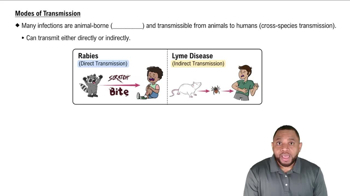
    A zoonotic disease is an infection that is transmitted from animals to humans, either directly or indirectly. Examples include rabies and Lyme disease.
  • What is not considered a vector of disease?

    A contaminated object is not considered a vector of disease; vectors are living organisms like mosquitoes, ticks, or fleas that transmit infections.
  • What is the difference between direct and indirect transmission of infections?

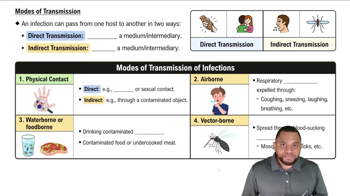
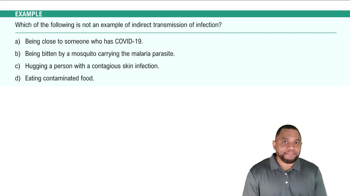
    Direct transmission occurs without a medium, such as through handshakes or hugs. Indirect transmission involves a medium or intermediary, like contaminated objects or vectors.
  • How can respiratory droplets contribute to the spread of infections?

    Respiratory droplets expelled by coughing, sneezing, laughing, or breathing can carry infectious agents. These droplets serve as a port of exit, allowing the infection to spread to another host.
  • What are some examples of indirect transmission through contaminated objects?

    Indirect transmission can occur when someone coughs or sneezes into their hand and then touches objects like remote controls, phones, or doorknobs. Another person touching these objects may become infected.
  • How do waterborne and foodborne infections typically spread?

    Waterborne infections spread through drinking contaminated water, while foodborne infections can result from eating contaminated or undercooked meat. Both are forms of indirect transmission.
  • What precautions should people take to avoid contracting Lyme disease in wooded areas?

    People should check themselves for ticks after spending time in the woods, especially in regions where Lyme disease is common. Ticks can attach to humans and transmit the infection if not removed properly.
  • How can zoonotic diseases be transmitted directly from animals to humans?

    Zoonotic diseases can be transmitted directly through actions like bites or scratches from infected animals. Rabies is an example of a disease spread this way.