Back

Systems of Objects with Friction quiz

Control buttons has been changed to "navigation" mode.
1/15
  • What must you consider for each object in a system of connected objects with friction?

    You must consider the friction acting on each individual object in the system.
  • What is the first step when solving problems involving systems of objects with friction?

    The first step is to draw free body diagrams for each object in the system.
  • What type of friction is present when objects are already moving?

    Kinetic friction is present when objects are already moving.
  • How do you calculate the kinetic friction force acting on an object?

    Kinetic friction force is calculated as the coefficient of kinetic friction times the normal force (f_k = μ_k * N).
  • What is the relationship between the acceleration of connected objects in a system?

    Connected objects always have the same acceleration and velocity.
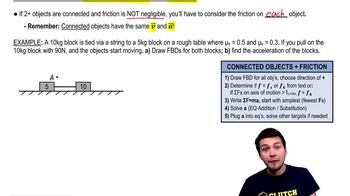
  • In the example, what is the applied force acting on the 10 kg block?

    The applied force acting on the 10 kg block is 90 N.
  • What forces are shown in the free body diagram of each block?

    The free body diagram includes tension, normal force, gravitational force, and frictional force for each block.
  • How do you determine the direction of positive acceleration in these problems?

    You assume the direction in which the blocks are being pulled (usually to the right) as positive.
  • What equation is used to relate the forces and acceleration for each block?

    Newton's second law, F = ma, is used for each block.
  • How do you express the friction force in terms of known quantities for each block?

    Friction force is expressed as μ_k times the block's mass times gravity (μ_k * m * g).
  • Why do you need to set up equations for both blocks in the system?

    You need equations for both blocks because tension is unknown and must be eliminated to solve for acceleration.
  • How do you eliminate the tension force from the system of equations?

    You add the two equations for each block so that the tension terms cancel out.
  • What is the final calculated acceleration of the system in the example?

    The final calculated acceleration of the system is 3.06 m/s².
  • What is the normal force acting on a block sliding horizontally?

    The normal force equals the gravitational force on the block (N = mg) if the block is sliding horizontally.
  • What is the purpose of drawing free body diagrams for each object in the system?

    Free body diagrams help identify all the forces acting on each object, which is essential for setting up the correct equations.