Skip to main content
Physics with Calculus
My Course
Learn
Exam Prep
AI Tutor
Study Guides
Textbook Solutions
Flashcards
Explore
Try the app
My Course
Learn
Exam Prep
AI Tutor
Study Guides
Textbook Solutions
Flashcards
Explore
Try the app
Back
Angular Momentum of a Point Mass quiz
You can tap to flip the card.
What is the main difference between a point mass and a rigid body in rotational problems?
You can tap to flip the card.
👆
What is the main difference between a point mass and a rigid body in rotational problems?
A point mass has no shape, radius, or volume, while a rigid body has a defined shape, radius, and volume.
Track progress
Control buttons has been changed to "navigation" mode.
1/15
Related flashcards
Related practice
Recommended videos
Angular Momentum of a Point Mass definitions
Angular Momentum of a Point Mass
15 Terms
Angular Momentum of a Point Mass
16. Angular Momentum
2 problems
Topic
David-Paige
Angular Momentum of Objects in Linear Motion
16. Angular Momentum
2 problems
Topic
David-Paige
16. Angular Momentum - Part 1 of 2
7 topics
16 problems
Chapter
Patrick
16. Angular Momentum - Part 2 of 2
1 topic
3 problems
Chapter
Guided course
08:35
Angular Momentum of a Point Mass
5338
views
47
rank
2
comments
Terms in this set (15)
Hide definitions
What is the main difference between a point mass and a rigid body in rotational problems?
A point mass has no shape, radius, or volume, while a rigid body has a defined shape, radius, and volume.
What is the equation for angular momentum (L) of a point mass in terms of moment of inertia and angular velocity?
The equation is L = Iω, where I is the moment of inertia and ω is the angular velocity.
How do you calculate the moment of inertia (I) for a point mass?
The moment of inertia for a point mass is I = mr^2, where m is mass and r is the distance to the axis of rotation.
How are linear velocity (v) and angular velocity (ω) related for a point mass moving in a circle?
They are related by the equation v = rω, where r is the radius of the circular path.
What is the equation for linear momentum (p) of a point mass?
Linear momentum is given by p = mv, where m is mass and v is velocity.
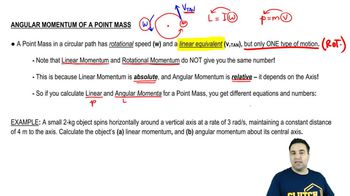
Why do linear momentum and angular momentum give different numerical values for a point mass?
They give different values because linear momentum is absolute, while angular momentum depends on the axis of rotation (the radius).
What is the equation for angular momentum (L) of a point mass in terms of mass, velocity, and radius?
The equation is L = mvr, where m is mass, v is velocity, and r is the distance to the axis.
In the example of a 2 kg point mass spinning at 3 rad/s at a 4 m radius, what is its linear velocity?
The linear velocity is v = rω = 4 × 3 = 12 m/s.
Using the above example, what is the linear momentum (p) of the point mass?
The linear momentum is p = mv = 2 × 12 = 24 kg·m/s.
Using the same example, what is the angular momentum (L) of the point mass?
The angular momentum is L = mvr = 2 × 12 × 4 = 96 kg·m²/s.
Under what condition would the numerical values of linear and angular momentum be the same for a point mass?
They would be the same if the radius r equals 1, but this is just a coincidence and not generally significant.
How do you find the angular momentum of an object in linear motion about an axis?
You use the equation L = mvr, where r is the perpendicular distance from the axis to the line of motion.
If an object is falling towards a bar and has velocity v and distance r from the axis, how do you calculate its angular momentum relative to the axis?
You calculate it using L = mvr, where m is the object's mass, v is its velocity, and r is the distance to the axis.
Is angular momentum an absolute or relative quantity, and why?
Angular momentum is a relative quantity because it depends on the chosen axis of rotation.
What is the plural form of 'momentum' as used in physics?
The plural form is 'momenta.'
 BackBack

 08:35
08:35