Back

Average Power of Waves on Strings quiz

Control buttons has been changed to "navigation" mode.
1/15
  • What does a wave carry as it moves along a string: energy or matter?

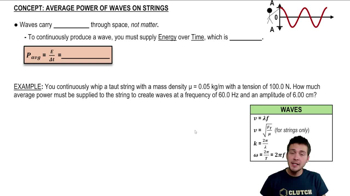
    A wave carries energy along a string, not matter.
  • What is the formula for the average power required to produce waves on a string?

    The formula is (1/2) * omega^2 * a^2 * v * mu.
  • In the average power formula, what does 'omega' represent?

    'Omega' represents the angular frequency of the wave.
  • How do you calculate angular frequency (omega) if you know the frequency (f)?

    Omega is calculated as omega = 2 * pi * f.
  • What does 'a' stand for in the average power formula for waves on a string?

    'a' stands for the amplitude of the wave.
  • How do you calculate the wave speed (v) on a string?

    Wave speed is calculated as v = sqrt(tension/mu).
  • What does 'mu' represent in the context of waves on a string?

    'Mu' is the mass density of the string.
  • If the amplitude is given in centimeters, what must you do before using it in the formula?

    You must convert the amplitude from centimeters to meters.
  • What is the calculated angular frequency (omega) for a frequency of 60 Hz?

    The angular frequency is approximately 377 radians per second.
  • What is the calculated wave speed if the tension is 100 N and mass density is 0.05 kg/m?

    The wave speed is 44.7 meters per second.
  • What is the average power required to maintain the wave in the example provided?

    The average power required is 572 watts.
  • What is the definition of power in the context of waves on a string?

    Power is the energy supplied per unit time to maintain the wave.
  • Why do you need to continuously supply energy to a string to produce waves?

    Because maintaining the wave requires continuous work to keep the string moving up and down.
  • Which two variables in the average power formula are squared?

    Omega (angular frequency) and amplitude (a) are both squared.
  • What is the significance of the formula's resemblance to the word 'wave'?

    It helps to remember the formula: omega^2, amplitude^2, v, and mu resemble the letters in 'wave' with mu replacing 'e'.