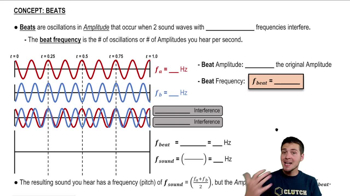
A beat is an oscillation in amplitude that occurs when two sound waves with similar but not identical frequencies interfere with each other.
How do constructive and destructive interference relate to beats?
Constructive interference occurs when the waves align and their amplitudes add, while destructive interference happens when they are out of sync and cancel each other, creating the varying amplitude pattern of beats.
What is the formula for calculating beat frequency?
The beat frequency is the absolute value of the difference between the two frequencies: f_beat = |f1 - f2|.
If two sound waves have frequencies of 8 Hz and 10 Hz, what is their beat frequency?
The beat frequency is |8 - 10| = 2 Hz.
What does the amplitude of the resulting wave from two interfering sound waves equal?
The amplitude of the resulting wave is the sum of the amplitudes of the individual waves.
How does the amplitude of the net wave change during a beat?
The amplitude varies from zero (when the waves cancel) to a maximum (when the waves add constructively), repeating this pattern over time.
What determines the pitch of the sound you hear from two interfering waves?
The pitch is determined by the average of the two frequencies.
How does the loudness of the sound change when beats are present?
The loudness oscillates at the beat frequency, increasing and decreasing as the waves interfere constructively and destructively.
What would you hear if two sound waves with a beat frequency of 2 Hz are played together?
You would hear the sound's loudness oscillate twice per second, producing a 'wow, wow' effect.
Why do beats only occur when the two frequencies are close together?
Beats occur when frequencies are similar because their interference creates a slowly varying amplitude; if the frequencies are very different, this pattern does not form.
How do you calculate the frequency of a sound wave if you know its wavelength and the speed of sound?
Use the formula f = v / λ, where v is the speed of sound and λ is the wavelength.
If the speed of sound is 343 m/s and the wavelength is 0.65 m, what is the frequency?
The frequency is 343 / 0.65 ≈ 527.7 Hz.
In the example with two musicians, what are the frequencies if their wavelengths are 0.65 m and 0.654 m?
The frequencies are approximately 527.7 Hz (for 0.65 m) and 524.5 Hz (for 0.654 m).
What is the beat frequency when two musicians play notes at 527.7 Hz and 524.5 Hz?
The beat frequency is |527.7 - 524.5| = 3.2 Hz.
What does a beat frequency of 3.2 Hz mean in terms of what you hear?
You would hear the loudness of the sound oscillate 3.2 times per second.
 Back
Back
 08:46
08:46