Back

Biot-Savart Law (Calculus) quiz

Control buttons has been changed to "navigation" mode.
1/15
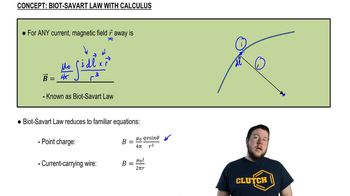
  • What is the general calculus form of the Biot-Savart Law for the magnetic field due to a current-carrying wire?

    It is \(\mu_0 / (4\pi) \int (I d\vec{l} \times \vec{r}) / r^3\), where \(I\) is current, \(d\vec{l}\) is an infinitesimal wire segment, and \(\vec{r}\) is the position vector.
  • In the Biot-Savart Law, what does the vector \(d\vec{l}\) represent?

    It represents a very small vector segment of the wire in the direction of the current.
  • What is the physical meaning of the cross product \(d\vec{l} \times \vec{r}\) in the Biot-Savart Law?

    It gives a vector perpendicular to both the direction of current and the position vector, determining the direction of the magnetic field.
  • How is the current \(I\) defined in terms of charge and time?

    Current is defined as \(I = dQ/dt\), the rate of flow of charge.
  • How can the Biot-Savart Law be applied to a single moving point charge?

    By substituting \(I = dQ/dt\) and recognizing \(d\vec{l}/dt\) as velocity, the law can be rewritten for a point charge.
  • What does the integral \(\int dq\) represent when applying the Biot-Savart Law to a single charge?

    It represents the total charge, which for a single charge is just \(q\).
  • What is the simplified Biot-Savart Law for a single moving charge?

    It is \(\mu_0 / (4\pi) \cdot Qv \sin(\theta) / r^2\), where \(Q\) is the charge, \(v\) is velocity, \(\theta\) is the angle between \(v\) and \(r\), and \(r\) is the distance.
  • What does \(\theta\) represent in the equation \(Qv \sin(\theta)\)?

    It is the angle between the velocity vector of the charge and the position vector from the charge to the field point.
  • Why can velocity and position be taken out of the integral when applying the Biot-Savart Law to a single charge?

    Because for a single charge, its velocity and position are constant during the integration over \(dq\).
  • What does the denominator \(r^3\) in the Biot-Savart Law integral represent?

    It represents the cube of the distance from the wire element to the point where the magnetic field is being calculated.
  • How does the Biot-Savart Law for a distributed current relate to the law for a single moving charge?

    The law for a distributed current reduces to the single charge case when the current is due to just one moving charge.
  • What is the physical significance of \(\mu_0 / (4\pi)\) in the Biot-Savart Law?

    It is a constant that sets the scale for the strength of the magnetic field produced by currents in free space.
  • What does the direction of \(d\vec{l}\) indicate in the Biot-Savart Law?

    It indicates the direction of current flow in the wire at that infinitesimal segment.
  • What is the result of integrating \(dq\) over a single point charge?

    The result is simply the charge \(q\) itself.
  • How does the Biot-Savart Law connect to familiar magnetic field equations for special cases?

    It reduces to the known equations for the magnetic field of a point charge and an infinitely long straight wire.