What is the first step when solving a two-dimensional force problem?
The first step is to draw the free body diagram, identifying all forces acting on the object.
How do you calculate the net force when forces act at angles in two dimensions?
Decompose each force into its x and y components, sum the components in each direction, and use the Pythagorean theorem to find the net force magnitude.
What trigonometric functions are used to decompose a force into x and y components?
Use cosine for the x component and sine for the y component, based on the angle from the horizontal.
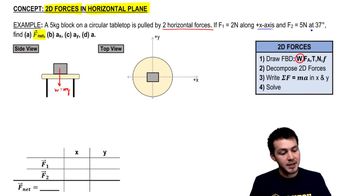
If a block is pulled by two horizontal forces, how do you determine the net force?
Add the x and y components of each force separately, then use the Pythagorean theorem to find the net force.
How do you calculate acceleration in the x or y direction for a block under multiple forces?
Use Newton's second law (F = ma) for each axis, dividing the net force in that direction by the mass.
What does it mean if the acceleration in the y-axis is zero for a block on a surface?
It means the block is in equilibrium vertically, so the upward and downward forces cancel each other.
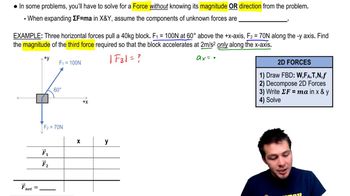
How do you solve for an unknown force in a two-dimensional force problem?
Write equations for the sum of forces in the x and y directions, set them equal to mass times acceleration, and solve for the unknown components.
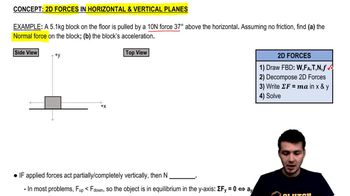
What is the normal force on a block if an upward force is applied at an angle?
The normal force equals the weight minus the vertical component of the applied force (N = mg - F_ay).
How does the normal force change if the applied force pushes down on the block?
The normal force increases and becomes greater than the weight of the block.
What happens to the normal force if the upward component of the applied force exceeds the block's weight?
The normal force becomes zero, and the block loses contact with the surface.
How do you find the magnitude of a force given its x and y components?
Use the Pythagorean theorem: magnitude = sqrt(Fx^2 + Fy^2).
What is the direction of a force given its x and y components?
The direction is found using the inverse tangent: θ = arctan(Fy/Fx).
If a block is pulled at 37° above the horizontal with a force of 10 N, what are the x and y components?
The x component is 8 N (10 cos 37°), and the y component is 6 N (10 sin 37°).
Why do you assume unknown force components are positive when setting up equations?
Assume they are positive to avoid sign errors; the solution will indicate the correct direction by the sign of the result.
How do you determine if a block will accelerate vertically when forces are applied?
Check if the sum of upward forces exceeds the sum of downward forces; if not, the block remains in vertical equilibrium.