Back

Kepler's Third Law for Elliptical Orbits quiz

Control buttons has been changed to "navigation" mode.
1/15
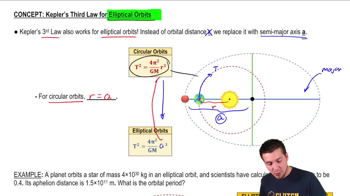
  • What variable replaces the orbital radius 'r' in Kepler's third law for elliptical orbits?

    The semi-major axis 'a' replaces the orbital radius 'r' in Kepler's third law for elliptical orbits.
  • How is the semi-major axis 'a' defined in an elliptical orbit?

    The semi-major axis 'a' is half the length of the major axis, which is the longest diameter of the ellipse.
  • What is the equation for Kepler's third law for elliptical orbits?

    The equation is T^2 = (4π^2 * a^3) / (G * M), where T is the orbital period, a is the semi-major axis, G is the gravitational constant, and M is the mass of the central body.
  • In the context of orbits, what is the relationship between circular and elliptical orbits regarding the semi-major axis?

    A circular orbit is a special case of an elliptical orbit where the radius 'r' is equal to the semi-major axis 'a'.
  • Why can't you use the instantaneous distance to the star in Kepler's third law for elliptical orbits?

    Because the distance to the star changes constantly in an elliptical orbit, making it unsuitable for the equation; instead, the semi-major axis 'a' is used.
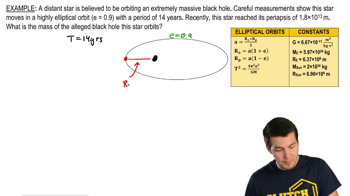
  • What formula relates the aphelion distance (RA) to the semi-major axis (a) and eccentricity (e)?

    The formula is RA = a(1 + e), where RA is the aphelion distance, a is the semi-major axis, and e is the eccentricity.
  • If you know only the aphelion distance and eccentricity, how do you solve for the semi-major axis?

    You rearrange the formula RA = a(1 + e) to solve for a: a = RA / (1 + e).
  • What is the value of the gravitational constant 'G' used in Kepler's third law calculations?

    The gravitational constant G is 6.67 × 10^-11 N·m^2/kg^2.
  • What does the orbital period 'T' represent in Kepler's third law?

    The orbital period 'T' is the time it takes for a planet or object to complete one full orbit around the central body.
  • In the example, what was the calculated orbital period in days for the planet?

    The calculated orbital period was about 156 days.
  • Why is it important to use parentheses carefully when plugging values into Kepler's third law equation?

    Because the equation involves exponents and multiple operations, using parentheses ensures the correct order of calculations.
  • What is the mass of the star used in the example calculation?

    The mass of the star used is 4 × 10^30 kg.
  • What is the value of the eccentricity 'e' used in the example problem?

    The eccentricity 'e' used is 0.4.
  • What is the formula for the semi-major axis if only the perihelion distance (RP) and eccentricity are known?

    The formula is RP = a(1 - e), where RP is the perihelion distance.
  • How does the orbital period of the example planet compare to Earth's orbital period?

    The example planet's period is 156 days, which is shorter than Earth's 365 days.